Ligue 1 2026/27 Season Preview: Every Club Rated and Predicted Final Table | 19 August 2026
Goal.mu analyses all 18 Ligue 1 clubs for 2026/27, assessing managers, summer changes and tactical outlook before predicting the complete final table.

Ligue 1 2026/27 Season Preview: Every Club Rated and Predicted Final Table | 19 August 2026
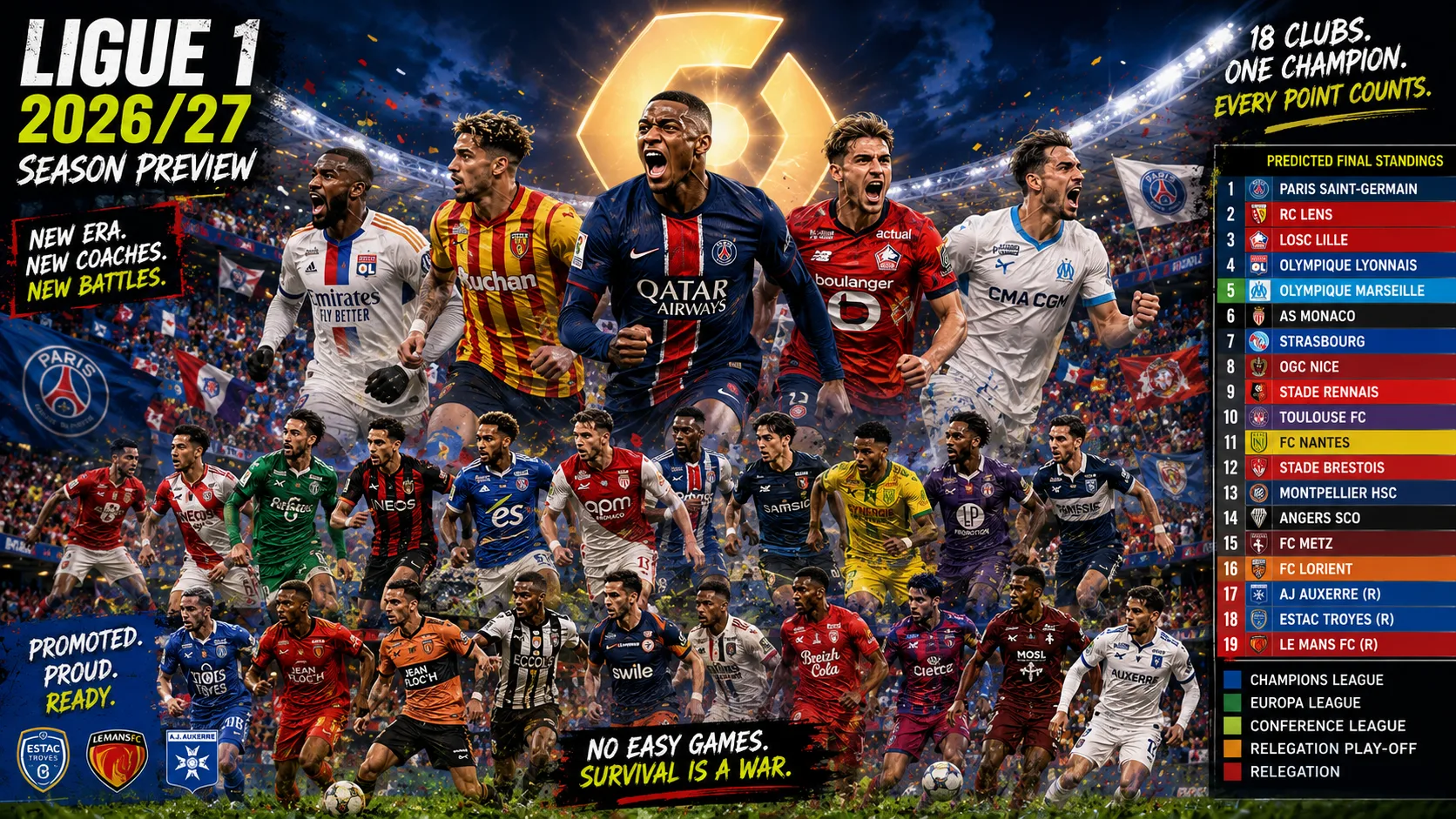
Ligue 1 2026/27 preview: Paris Saint-Germain begin as defending champions, Lens enter with renewed belief after finishing second, Lille and Lyon remain powerful Champions League contenders, while promoted Troyes and Le Mans bring two very different survival stories.
This Goal.mu season guide was researched on 19 August 2026 using official Ligue 1 and club material alongside current French football reporting. One defining theme is unprecedented managerial upheaval: 12 of the 18 clubs changed head coach during the summer, the highest figure recorded in Ligue 1 in the 21st century.
Goal.mu Predicted Ligue 1 2026/27 Final Table
| Pos. | Club | Projection |
|---|---|---|
| 1 | Paris Saint-Germain | Champions |
| 2 | RC Lens | Champions League |
| 3 | LOSC Lille | Champions League |
| 4 | Olympique Lyonnais | Champions League |
| 5 | Olympique de Marseille | European race |
| 6 | Stade Rennais | European race |
| 7 | AS Monaco | European race |
| 8 | RC Strasbourg Alsace | Mid-table |
| 9 | Toulouse FC | Mid-table |
| 10 | OGC Nice | Mid-table |
| 11 | FC Lorient | Mid-table |
| 12 | Paris FC | Mid-table |
| 13 | Stade Brestois 29 | Mid-table |
| 14 | Le Havre AC | Survival |
| 15 | Angers SCO | Survival |
| 16 | AJ Auxerre | Relegation play-off |
| 17 | ESTAC Troyes | Relegated |
| 18 | Le Mans FC | Relegated |
The Big Picture
PSG remain the overwhelming benchmark, but Lens have proved they can sustain elite domestic form and Lille, Lyon and Marseille all possess the quality to make the race behind the champions highly competitive. Monaco are rebuilding under Filipe Luís, Strasbourg are changing coach after major player turnover, and several mid-table sides begin new tactical cycles.
The relegation battle should be equally compelling. Auxerre survived only on the final day last season, Angers and Le Havre continue to operate with small financial margins, while Troyes and Le Mans must translate excellent second-tier structures into top-flight points. The promoted clubs are organised enough to make survival far from automatic for established sides.
1. Paris Saint-Germain — Predicted Finish: 1st
Head coach: Luis Enrique
2025/26 context: Defending Ligue 1 champions and back-to-back European champions
Summer 2026: Ferran Torres has joined until 2031, adding another flexible forward to an already elite attacking group.
Paris Saint-Germain remain the obvious benchmark in France. Luis Enrique enters a fourth consecutive Ligue 1 campaign with a chance to achieve something historically significant: a fourth straight domestic title as coach. PSG have already normalised domination in France, but the more telling measure is how successfully the Spanish coach has aligned that domestic superiority with European performance.
The squad still possesses the league’s deepest technical base. Vitinha and João Neves provide control in midfield, while Désiré Doué, Khvicha Kvaratskhelia, Bradley Barcola and Ousmane Dembélé give Enrique multiple ways to stretch opponents. Ferran Torres’ arrival adds another intelligent forward comfortable across the front line. PSG can now rotate without fundamentally changing the nature of their attacking game.
The risk is workload. PSG’s calendar is heavier than anyone else’s and their players have accumulated extraordinary minutes across club and international football. Enrique will again need to manage intensity, particularly after a summer shaped by the World Cup. Lens have already demonstrated in the Trophée des Champions that PSG can be made uncomfortable when opponents press aggressively and defend with emotional commitment.
Even so, the structural gap remains substantial. PSG can win matches through possession, transitions, individual quality or bench depth, and their defensive control has improved markedly under Enrique. Goal.mu projects another title. The championship may be closer than in some recent seasons, but over 34 matches PSG retain the highest floor and the strongest capacity to survive injuries, rotation and poor individual performances.
2. RC Lens — Predicted Finish: 2nd
Head coach: Dino Toppmöller
2025/26 context: Second in 2025/26; one of the best league seasons in club history
Summer 2026: Lens have changed coach again, but begin with confidence after beating PSG to win the Trophée des Champions.
Lens enter the season with belief that would have seemed unrealistic only a few years ago. Their second-place finish in 2025/26 was not a lucky run: they produced the second-best points-per-match campaign in club history and spent long stretches genuinely challenging Paris Saint-Germain.
The major question is continuity after another coaching change. Dino Toppmöller succeeds Pierre Sage, meaning Lens begin a third consecutive season under a new head coach. That would normally create concern, yet the club’s recruitment model and footballing identity have become strong enough to absorb managerial turnover better than most. Toppmöller inherits a group accustomed to high pressing, aggressive wing play and the emotional intensity of Bollaert.
Winning the Trophée des Champions against PSG provides an immediate psychological lift. The greater challenge will be reproducing last season’s consistency while competing in the Champions League. Lens cannot rotate with the same comfort as PSG, so how Toppmöller manages European weeks may determine whether they stay in the top two.
Goal.mu expects Lens to remain PSG’s closest domestic challenger. Their home advantage, collective discipline and increasingly sophisticated squad planning make another podium finish likely. Second place is the projection, although the gap to Lille, Lyon and Marseille should be narrow enough that even a modest European hangover could change the order.
3. LOSC Lille — Predicted Finish: 3rd
Head coach: Davide Ancelotti
2025/26 context: Third with 61 points in 2025/26; direct Champions League qualification
Summer 2026: Davide Ancelotti begins his first Ligue 1 season after Bruno Genesio’s departure, inheriting a talented young midfield led by Ayyoub Bouaddi.
Lille return to the Champions League after finishing third last season, but they do so under a new coach. Davide Ancelotti arrives with a famous surname and extensive elite-level experience as an assistant, but this is his first major test as the principal decision-maker in a top European league.
The squad offers him an excellent platform. Ayyoub Bouaddi emerged as one of Ligue 1’s best young midfielders last season, combining physical presence with unusual composure. Lille also retain a strong defensive structure and enough attacking variety to score late, something they did repeatedly in 2025/26. Their ability to produce decisive goals in the final quarter-hour became one of the defining statistical features of the campaign.
Champions League football complicates Ancelotti’s adaptation. Lille will need to learn his methods while facing stronger European opposition and maintaining domestic consistency. That is a demanding first season, especially for a coach who must establish authority quickly.
Nevertheless, Lille’s recruitment, academy development and organisational strength make them more resilient than many clubs undergoing a coaching transition. Goal.mu predicts third. They may not match PSG’s depth or Lens’ emotional momentum, but their midfield quality and established squad structure should keep them securely in the Champions League conversation.
4. Olympique Lyonnais — Predicted Finish: 4th
Head coach: Paulo Fonseca
2025/26 context: Fourth in 2025/26, missing the podium by one point
Summer 2026: Loïs Openda has arrived on loan, Corentin Tolisso has extended, and Felix Bacher is among the defensive additions.
Lyon finished only one point behind Lille last season and begin 2026/27 with one of the most intriguing squads in France. Paulo Fonseca provides coaching continuity at a club that has rarely enjoyed it in recent years, and that stability could prove decisive in a congested Champions League race.
The summer has brought meaningful reinforcement. Loïs Openda arrives on loan and gives Lyon a proven high-speed striker capable of attacking space behind defensive lines. Corentin Tolisso’s extension preserves leadership and midfield intelligence, while Felix Bacher strengthens the defence. The club have also continued to invest in younger players despite the financial and ownership turbulence surrounding the wider organisation.
Fonseca’s football demands bravery in possession and coordinated pressing. At its best, Lyon can pin opponents deep and create chances through combinations rather than relying solely on individual moments. The weakness remains defensive exposure when attacks break down, particularly against sides with pace in transition.
Goal.mu projects fourth. Lyon have the talent to finish second, but the club’s off-field uncertainty and the demands of European football create more volatility than at Lens or Lille. If Openda settles immediately and the defensive structure improves, a podium finish is very achievable.
5. Olympique de Marseille — Predicted Finish: 5th
Head coach: Bruno Genesio
2025/26 context: European qualification after a turbulent 2025/26 season
Summer 2026: Bruno Genesio takes over amid a new sporting structure, with Igor Paixão expected to become one of the attacking focal points.
Marseille begin another reset, though this one feels more measured than some of the dramatic rebuilds of recent years. Bruno Genesio replaces Habib Beye and arrives with 300 Ligue 1 matches of coaching experience, the most of any manager starting the season. That experience matters at a club where tactical work is inseparable from expectation and pressure.
The wider structure has also changed, with a new president and sporting leadership attempting to balance competitiveness with financial discipline. Marseille are operating under DNCG constraints and have made clear that player sales will be important. That means Genesio must create stability while the squad may continue to evolve until the end of the window.
Igor Paixão is one of the players expected to take greater attacking responsibility. Marseille still have the capacity to overwhelm opponents at the Vélodrome, where matches produced more total goals than at any other Ligue 1 stadium last season. The issue is controlling those games rather than simply making them spectacular.
Goal.mu predicts fifth. Marseille have enough talent for the Champions League places, but their transition is deeper than at Lyon or Lille. Genesio should make them more coherent, yet European workload and the possibility of further sales make a top-three prediction too aggressive at this stage.
6. Stade Rennais — Predicted Finish: 6th
Head coach: Franck Haise
2025/26 context: Finished in the European race after a strong second half of 2025/26
Summer 2026: Franck Haise remains in charge, giving Rennes a valuable degree of continuity compared with many rivals.
Rennes improved significantly under Franck Haise and enter the new season with a tactical identity that now looks more settled. Haise’s teams are at their best when the press is aggressive, the wing-backs advance together and midfield runners attack the spaces created by mobile forwards.
The attacking talent remains considerable. Rennes have enough speed and technique to trouble any side in France, and last season’s late push showed that the group can sustain high-level form. The issue is consistency: periods of excellent football have too often been followed by flat performances against teams they are expected to dominate.
Haise’s continuity is therefore important. Twelve Ligue 1 clubs changed coach this summer, so Rennes start with an advantage in automatisms and relationships. That can be particularly valuable in August and September while other teams are still learning new systems.
Goal.mu projects sixth. Rennes are capable of reaching the Champions League, but the competition above them is fierce. Their season may depend on whether they improve chance conversion and avoid the defensive lapses that cost points in otherwise strong performances.
7. AS Monaco — Predicted Finish: 7th
Head coach: Filipe Luís
2025/26 context: Seventh in 2025/26 after falling away late in the European race
Summer 2026: Filipe Luís replaces Sébastien Pocognoli and has been tasked with returning Monaco to the Champions League places.
Monaco are one of the league’s great unknowns. Their seventh-place finish last season was disappointing given the individual quality of the squad, and the club have responded by appointing Filipe Luís after ending Sébastien Pocognoli’s tenure.
The Brazilian coach arrives with a strong reputation after major success in South America. His challenge is to translate a proactive, aggressive model into European club football while managing a squad that has often looked excellent in attack but vulnerable to momentum swings. Folarin Balogun remains an important reference after an impressive scoring run last season, and Monaco continue to possess some of France’s most valuable young talent.
The upside is clear. Few clubs outside PSG can match Monaco for athleticism and individual technique. The downside is that another tactical reset could delay the consistency required for a top-four finish. European football will further reduce training time.
Goal.mu projects seventh, but this is deliberately conservative. Monaco have top-three talent and could quickly outperform this forecast if Filipe Luís adapts well. Until the defensive structure and match control improve, however, there is too much uncertainty to rank them above more settled rivals.
8. RC Strasbourg Alsace — Predicted Finish: 8th
Head coach: Hugo Oliveira
2025/26 context: A strong 2025/26 season built around the youngest starting line-ups in Europe’s top five leagues
Summer 2026: Hugo Oliveira arrives from Famalicão after major player turnover, including the departures of Mike Penders and Emmanuel Emegha.
Strasbourg were one of Europe’s most fascinating young teams last season. Their starting line-ups had the lowest average age in any of the top five leagues, yet they still competed effectively for Europe and played with unusual tactical confidence.
That project now enters a difficult transition. Hugo Oliveira replaces Liam Rosenior and inherits a squad affected by significant turnover. Mike Penders and Emmanuel Emegha have moved on, while other young players have attracted attention. Strasbourg’s model is designed to tolerate those departures, but there is always a point at which replacing too much talent at once becomes destabilising.
Oliveira’s work at Famalicão is encouraging. He led the Portuguese club to the best league finish in their history and brings a background that combines goalkeeper coaching with broader tactical development. Strasbourg should remain brave in possession and committed to youth.
Goal.mu projects eighth. The ceiling remains European qualification, but asking another extremely young squad to absorb a new coach and several major departures is demanding. They should still be one of Ligue 1’s most watchable sides, even if the table shows modest regression.
9. Toulouse FC — Predicted Finish: 9th
Head coach: Jens Berthel Askou
2025/26 context: Solid mid-table campaign in 2025/26
Summer 2026: Jens Berthel Askou replaces Carles Martínez Novell after an impressive spell in Scotland; Yann Gboho remains the main one-against-one threat.
Toulouse are changing coach after several seasons of tactical continuity under Carles Martínez Novell. Jens Berthel Askou arrives from Motherwell with a reputation for energetic, player-centred coaching and a willingness to give attacking players freedom within a clear collective structure.
Yann Gboho is central to that plan. He led Ligue 1 for successful dribbles last season with 77 and also produced the best goalscoring campaign of his career. His capacity to beat defenders gives Toulouse an important solution against compact blocks and allows the team to progress without relying exclusively on structured passing.
The coaching transition creates uncertainty, but Toulouse’s recruitment model and data-driven approach are designed to survive changes in personnel. Their squad remains young enough to improve but experienced enough to avoid being overwhelmed by the league.
Goal.mu predicts ninth. Toulouse are unlikely to have the depth for a sustained Champions League push, but they have enough technical quality to finish comfortably in the top half. If Askou’s pressing system clicks quickly, they could become one of the surprise European challengers.
10. OGC Nice — Predicted Finish: 10th
Head coach: Olivier Pantaloni
2025/26 context: Survived a difficult 2025/26 season after spending time close to the relegation play-off
Summer 2026: Olivier Pantaloni takes over after guiding Lorient to an excellent top-half campaign; Nice continue to develop young attacking options.
Nice enter the season after one of the most turbulent campaigns among France’s established European clubs. Last year brought coaching changes, poor runs and genuine relegation concern before survival was secured. The response is to appoint Olivier Pantaloni, whose work at Lorient was among the most impressive coaching performances of 2025/26.
Pantaloni’s teams are usually clear rather than complicated. He values compactness, efficient transitions and players who understand their defensive roles. That should help a Nice side whose confidence was damaged by long losing sequences. The squad still contains enough athletic and technical quality to recover quickly.
The attacking question is important. Nice need a dependable No.9 and greater consistency from the wide players. Victor Orakpo is one of the younger forwards attempting to establish himself, while the club may still make further moves before the transfer deadline.
Goal.mu projects tenth. This is a recovery prediction rather than a return to the Champions League conversation. Pantaloni should make Nice harder to beat, and that alone would represent major progress after last season’s instability.
11. FC Lorient — Predicted Finish: 11th
Head coach: Alexandre Dujeux
2025/26 context: Top-half finish in 2025/26 after an excellent return to Ligue 1
Summer 2026: After Olivier Pantaloni’s departure, Lorient begin a new cycle while trying to retain the collective structure that delivered last season’s overachievement.
Lorient were one of the surprise successes of last season. Promoted back to Ligue 1, they finished tenth and combined experienced leaders with energetic young players. The departure of Olivier Pantaloni therefore represents a genuine test of the club’s ability to preserve its footballing identity beyond one coach.
Alexandre Dujeux brings substantial Ligue 1 experience and a reputation for pragmatic organisation. Lorient do not need a dramatic tactical revolution; the priority is to retain the compactness, transition quality and confidence that made them difficult opponents throughout 2025/26.
The squad still contains players capable of hurting teams on the break, and the Moustoir remains an awkward venue. The challenge is expectation. Last season’s tenth place raises the benchmark, but repeating it after losing a successful coach may be difficult.
Goal.mu projects 11th. That would represent consolidation rather than decline. Lorient should remain well above the relegation line if the defensive structure survives the managerial change.
12. Paris FC — Predicted Finish: 12th
Head coach: Liam Rosenior
2025/26 context: Established themselves in Ligue 1 during 2025/26
Summer 2026: Liam Rosenior returns to France after his successful Strasbourg spell and takes over a club with strong financial backing and growing ambition.
Paris FC’s first season back in Ligue 1 was about proving that the project had substance beyond investment and publicity. They achieved that, remaining in the division and producing enough competitive performances to suggest that the club can become a durable top-flight presence.
The appointment of Liam Rosenior is particularly interesting. His Strasbourg side were among the most sophisticated young teams in France, and he now inherits a club with resources, an expanding recruitment network and the ambition to grow beyond survival. Rosenior should encourage greater control in possession and a more coordinated press.
The challenge is turning investment into chemistry. Paris FC have changed rapidly and will continue to attract new players, but a successful Ligue 1 team requires stable relationships as much as talent. Their derby with PSG also adds another layer of attention and expectation.
Goal.mu predicts 12th. A top-half finish is possible if Rosenior’s ideas settle quickly, but the club is still constructing its identity. This season should be another step towards becoming an established member of the division.
13. Stade Brestois 29 — Predicted Finish: 13th
Head coach: Julien Lachuer
2025/26 context: A solid 2025/26 season clear of relegation
Summer 2026: Julien Lachuer succeeds Éric Roy and attempts to preserve the collective identity built during Brest’s remarkable rise.
Brest begin the season in emotionally difficult circumstances following the death of Éric Roy, the coach who transformed the club’s modern history. Julien Lachuer, previously part of Roy’s staff, now takes charge and faces the delicate task of preserving continuity while establishing his own authority.
The advantage is familiarity. Lachuer knows the players, the internal culture and the tactical principles that made Brest greater than the sum of their parts. Their best football has been built on collective discipline, set-piece threat and an ability to compete physically without abandoning technical ambition.
The concern is whether the squad can continue to outperform its budget after several years of exceptional performance. Regression is always possible when a club has been operating close to its ceiling, and a new head coach inevitably changes dynamics.
Goal.mu predicts 13th. Brest should still have enough organisation and home strength to avoid a serious relegation battle, but matching the heights of recent seasons would be a substantial achievement in the circumstances.
14. Le Havre AC — Predicted Finish: 14th
Head coach: Didier Digard
2025/26 context: Survived and finished strongly in 2025/26
Summer 2026: Didier Digard remains in charge, giving Le Havre one of the league’s more stable coaching situations.
Le Havre have repeatedly found ways to survive despite operating with one of Ligue 1’s smallest budgets. Didier Digard deserves considerable credit for that resilience. His side finished last season with improving form and showed that clear defensive organisation can compensate for limited resources.
The squad is built for survival rather than stylistic glamour. Le Havre must remain compact, defend their penalty area well and maximise set pieces. Their best path to points is often through keeping matches close until the final half-hour.
Coaching continuity is a major advantage in a league where two-thirds of clubs changed manager during the summer. Digard’s players already understand the defensive distances and pressing triggers required, which should help them start more quickly than several rivals.
Goal.mu predicts 14th. Le Havre will again spend time looking over their shoulder, but experience in relegation pressure and a stable tactical identity should keep them above the bottom three.
15. Angers SCO — Predicted Finish: 15th
Head coach: Stéphane Gilli
2025/26 context: Survived in 2025/26 with remarkable efficiency when leading matches
Summer 2026: Stéphane Gilli arrives after his Paris FC spell and takes over a club that lost only two points from winning positions last season.
Angers were one of the most efficient teams in Europe when protecting a lead last season. They dropped only two points from winning positions, a remarkable statistic for a club operating with modest resources. That discipline was central to survival.
The summer brings a coaching change. Stéphane Gilli arrives after his time with Paris FC and must preserve Angers’ resilience while giving the side more attacking solutions. His fiery personality may fit the emotional demands of the Stade Raymond Kopa, but the team cannot rely on narrow margins forever.
Angers’ squad is unlikely to dominate many matches, so set pieces, transition efficiency and defensive concentration remain essential. The challenge is creating enough chances when opponents give them possession rather than space.
Goal.mu projects 15th. Survival is achievable, but the gap to Auxerre, Troyes and Le Mans may be extremely small. Angers’ experience and proven ability to manage leads give them the edge.
16. AJ Auxerre — Predicted Finish: 16th
Head coach: Will Still
2025/26 context: Fifteenth in 2025/26 after surviving on the final day
Summer 2026: Will Still replaces Christophe Pélissier; Auxerre have invested around €16 million and made Danny Namaso’s move permanent.
Auxerre’s survival last season was dramatic. They spent 210 days in the bottom three and only secured their status on the final weekend with a superb away win at Lille. That escape closed Christophe Pélissier’s long and successful cycle and opened a new one under Will Still.
Still represents a clear stylistic shift. His teams press aggressively and play with more front-foot ambition, whereas Pélissier’s survival model was often pragmatic. Auxerre have backed that change with roughly €16 million of investment, including the permanent signing of Danny Namaso.
The upside is obvious: Auxerre could become more proactive and less dependent on defensive resistance. The risk is equally clear. A team that spent most of last season in danger is now learning a new system, and pressing mistakes can be punished brutally in Ligue 1.
Goal.mu projects 16th and the promotion/relegation play-off position. Auxerre have strengthened enough to survive outright, but the tactical transition and last season’s underlying vulnerability make them difficult to rank higher before competitive evidence emerges.
17. ESTAC Troyes — Predicted Finish: 17th
Head coach: Stéphane Dumont
2025/26 context: Ligue 2 champions in 2025/26
Summer 2026: Stéphane Dumont leads Troyes back to Ligue 1 after combining one of Ligue 2’s best attacks with its strongest defensive record during the promotion run.
Troyes return to Ligue 1 as second-tier champions and do so with a stronger structural case for survival than many promoted sides. Stéphane Dumont’s team were not merely effective in one phase of the game: during the promotion season they combined attacking productivity with outstanding defensive numbers.
That balance is the reason Troyes should not be dismissed. Dumont has built a side comfortable controlling matches but also disciplined enough to defend without the ball. The step up, however, changes the speed of every decision. Opponents will press harder, transition faster and punish mistakes that were survivable in Ligue 2.
Troyes must therefore preserve their collective identity while adding enough individual top-flight quality before the window closes. Home form will be decisive. Newly promoted clubs rarely survive if they cannot turn their own stadium into a reliable source of points.
Goal.mu projects 17th, narrowly relegated. This is a marginal call rather than an expectation of collapse. Troyes’ organisation gives them a genuine chance, but the established sides around the bottom have more Ligue 1 experience and deeper squads.
18. Le Mans FC — Predicted Finish: 18th
Head coach: Patrick Videira
2025/26 context: Second in Ligue 2 with 62 points; promoted for a second consecutive season
Summer 2026: Louis Mafouta, Billal Brahimi and Yasser Larouci are among the reinforcements as Le Mans return to Ligue 1 after 16 years.
Le Mans are the romantic story of the 2026/27 season. They have completed back-to-back promotions, rising from the National to Ligue 1 under Patrick Videira, and return to the top division for the first time in 16 years.
Videira’s influence is enormous. His team lost only four of 34 league matches last season and built promotion around intensity, character and collective belief. The club have attempted to add experience without destroying that chemistry. Louis Mafouta arrives after scoring 15 Ligue 2 goals for Guingamp, Billal Brahimi returns with top-flight experience and Yasser Larouci adds depth on the left.
The support is also significant. Le Mans stopped their season-ticket campaign after reaching a club-record 13,500 subscribers, evidence of the energy surrounding the return. Emotional momentum can matter in the first months, especially at home.
The problem is the size of the leap. Le Mans were playing in the third tier only two seasons ago, and depth becomes critical once injuries and suspensions arrive. Goal.mu projects 18th, but they are capable of making that prediction look foolish. Their collective structure is strong enough to compete; the decisive question is whether individual quality can keep pace with Ligue 1.
Final Verdict
Goal.mu expects PSG to retain the title, with Lens again their closest challenger. Lille and Lyon complete the projected Champions League places, while Marseille, Rennes and Monaco form the next European tier. The middle of the table should be exceptionally compressed because so many clubs are adapting to new coaches.
At the bottom, Auxerre are projected into the play-off, with Troyes and Le Mans narrowly relegated. Those calls carry considerable uncertainty: both promoted clubs have coherent coaching projects, and a strong first ten matches could completely change the survival picture.
The content provided in this article is intended solely for informational and entertainment purposes. Betting and gambling involve significant risks, including the potential loss of the principal amount wagered. Readers should be aware of their local regulations and laws concerning online betting and gambling. Always gamble responsibly, knowing that outcomes are unpredictable and can lead to financial losses.
If you or someone you know may have a gambling problem, please seek help. Many organisations provide resources and support for individuals struggling with gambling-related harm. Remember, the best bet is always a well-informed decision.
Never gamble with funds that are essential for your daily life, and always set limits to ensure that you do not gamble more than you can afford to lose. The thrill of betting should never overshadow the potential consequences of financial loss. Stay safe, stay informed, and gamble responsibly.