
Norway at World Cup 2026: Team Preview, History, Key Players & Prediction
Norway at World Cup 2026: Team Preview, History, Key Players & Prediction
Norway World Cup 2026 preview: after 28 years away from the finals, Ståle Solbakken brings a powerful, pragmatic and suddenly dangerous side to North America, with Erling Haaland and Martin Ødegaard giving Norway the kind of elite attacking edge that can trouble even the strongest opponents.
Norway’s return to the World Cup is one of the most intriguing stories of Group I. This is not just a sentimental comeback after a long absence. It is the arrival of a national team that finally has the right blend of structure, belief and world-class attacking quality. For years, Norway had famous players without enough collective momentum. Now they have both.
Solbakken’s side are not romantic dreamers. Their football is practical, direct and designed around maximising the strengths of their most decisive players. Haaland is the obvious reference point, a striker whose movement, physical power and finishing instincts can make any tactical plan look simple. Ødegaard is the captain and creator, the player who gives Norway rhythm, vision and the ability to find gaps before they fully appear.
Group I is demanding. France are one of the tournament favourites, Senegal are experienced and physically powerful, and Iraq arrive with an emotional underdog story after returning to the World Cup for the first time in 40 years. Norway should beat Iraq, can seriously challenge Senegal and will need a disciplined counter-attacking performance against France. The margins may be narrow, but Norway have the weapons to make this campaign memorable.
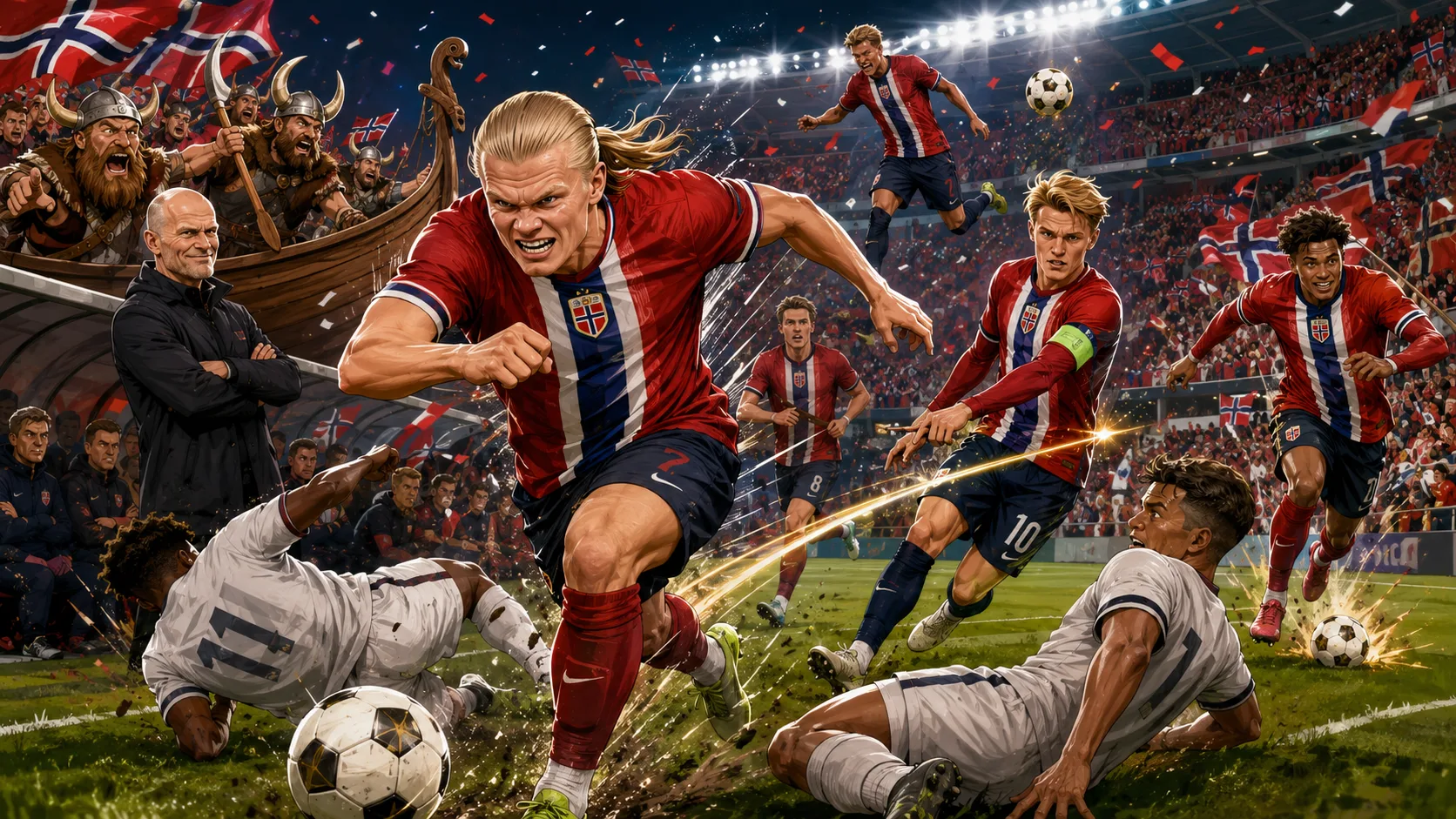
Team Overview
Norway arrive at World Cup 2026 with their strongest tournament side for a generation. Their last appearance at the finals came in 1998, when Solbakken himself was part of the squad. That context matters because this group is carrying the weight of a 28-year wait, but also the excitement of a side capable of doing more than simply participating.
The headline names are impossible to ignore. Haaland gives Norway one of the best finishers in world football. Ødegaard gives them a creative captain who can dictate tempo, feed runners and control attacking phases. Alexander Sørloth adds size, movement and a second major penalty-box threat. Antonio Nusa gives them dribbling, width and unpredictability. Sander Berge provides the balance that allows the more glamorous players to function.
What makes Norway dangerous is that the system is built to serve those strengths rather than hide them. Solbakken does not ask Norway to play like a possession-heavy superpower. He wants them to be efficient, vertical and tactically mature. When space appears behind a defence, the first instinct is to find Haaland. When teams sit deep, Ødegaard’s passing and Nusa’s dribbling become essential.
This is still not a flawless squad. Defensive depth and tournament experience remain concerns. Norway have elite attackers, but they have not been regulars at major tournaments for decades. The speed of World Cup football, the heat, the travel and the pressure of expectation will test them.
Still, there is a sense that this Norway team are not arriving by accident. They topped their European qualifying group, developed a more complete build-up structure and grew in confidence even when important players had injury problems. That combination of talent and tactical evolution gives them a serious chance of reaching the knockout rounds.
World Cup History
Norway’s World Cup history is limited, but it contains several memorable moments. Their first appearance came in 1938, when they reached the Round of 16. They had to wait until 1994 to return, appearing in the United States in a tight group where they competed well but went out early on goals scored despite finishing level on points with the other teams in the section.
The most famous Norwegian World Cup memory came in 1998. Norway were drawn with Brazil, Morocco and Scotland. They opened with draws against Morocco and Scotland, then produced one of the great shocks of the tournament by beating Brazil 2-1. Brazil had already qualified, but the result remains iconic in Norwegian football. Solbakken was an unused substitute that night, but the victory became part of the national team’s mythology.
Norway reached the Round of 16 in 1998 before losing to Italy. That remains their best modern World Cup campaign. Since then, they have spent nearly three decades trying to return, often producing talented players without finding the collective consistency required to qualify.
That long absence makes 2026 especially important. Haaland and Ødegaard are not just stars playing their first World Cup. They are symbols of a generation that has restored Norway’s relevance. Supporters who grew up hearing about 1998 now get to watch a side with genuine firepower of its own.
The challenge is to create a new reference point. Beating Brazil in 1998 will always be celebrated, but this generation does not want to live in the shadow of that result. They have the attacking quality to write a different story, one built around Haaland’s goals, Ødegaard’s control and the possibility of a knockout-stage run.
Road to World Cup 2026
Norway’s qualification campaign was a statement. They won UEFA Group I and returned to the finals for the first time since 1998. The numbers told the story of a team with attacking power and growing defensive control: eight wins, a huge goal return and enough authority to finish ahead of traditionally dangerous opponents.
Haaland was the defining figure. His scoring rate in qualification was extraordinary, and his presence gave Norway a constant route to goal. Opponents knew what was coming, but stopping it was another matter. When Norway found space in transition, Haaland punished it. When they delivered early crosses or slipped passes behind the line, he attacked them with frightening precision.
Ødegaard’s influence was just as important. The captain provided assists, dictated rhythm and gave Norway a level of technical leadership they had lacked in previous cycles. Even when he had injury concerns, his presence shaped the team’s confidence and attacking identity.
Norway also improved structurally. In earlier campaigns, they were sometimes too dependent on moments from star players. During this cycle, Solbakken built better defensive organisation and improved the quality of build-up from the back. The emergence of left-footed centre-back Torbjørn Heggem alongside Kristoffer Ajer gave the side more comfort in possession and improved passing angles.
The result was a qualification campaign that felt like the end of a long frustration. Norway were no longer nearly men. They were group winners, with a squad that had earned its place and a forward line that opponents could not treat lightly.
The Coach
Ståle Solbakken is a manager shaped by toughness, discipline and reality. He was a Norway international, part of the 1998 World Cup squad, and later became a coach after his playing career ended in dramatic circumstances. A heart attack during a training session in 2001 forced him into retirement, but it also began a long managerial life.
Since then, Solbakken has spent almost every year in football management. He has coached Copenhagen, Wolves, Cologne and Norway, building a reputation for clear principles rather than tactical romance. He is not a naive coach. He wants results, organisation and efficiency.
That worldview suits international football. National teams do not have months to build complex systems. They need clear frameworks that players can execute quickly. Solbakken has given Norway that. His team defend zonally, attack with purpose and try to move through the lines quickly when opportunities appear.
His tactical flexibility is important. Norway usually operate from a 4-3-3, but the shape can become a 3-5-2 when Julian Ryerson pushes high and Nusa holds width on the left. Solbakken has also tested a flatter 4-4-2, especially when trying to keep Haaland and Sørloth close to goal.
World Cup 2026 is his biggest stage as Norway manager. Having failed to qualify for Euro 2024, he has now delivered the country’s first major tournament appearance since Euro 2000. That achievement has already transformed his legacy. A knockout-stage place would elevate it further.
Star Player
Erling Haaland is Norway’s star player and one of the most dangerous forwards at the entire tournament. His role is simple in theory and devastating in practice: attack space, finish chances and make defenders uncomfortable from the first whistle.
Haaland is not a striker who needs to dominate touches. He can be quiet for long spells and then decide the match with one run. That is what makes him so dangerous at international level. Norway do not need to control 65 per cent of the ball to create threat. They need to find Haaland at the right moment.
His international scoring record has already changed Norwegian football history. Jørgen Juve’s long-standing national scoring record once looked secure for generations, but Haaland broke through at such speed that the old marks quickly fell. He is now the standard for every Norwegian striker who follows.
At World Cup 2026, he will be under huge focus. This is his first World Cup, and the global stage will test how Norway can involve him against different defensive plans. Iraq may sit compact, Senegal may challenge physically, and France may force Norway to counter from deep.
If Norway supply him well, Haaland can win matches almost alone. If opponents isolate him, Solbakken needs others to step forward. That is why Ødegaard, Nusa and Sørloth are so important. Haaland may be the finisher, but the structure around him must function.
One to Watch
Antonio Nusa is Norway’s one to watch. He gives the team a different kind of threat: dribbling, width, acceleration and creative unpredictability. While Haaland attacks space through the middle, Nusa can create it from the left.
Nusa is the type of winger who changes the mood of a match when he receives the ball. He wants to run at defenders, draw contact, shift direction and create panic. In a tournament where Norway may face both deep blocks and elite defensive units, that ability is vital.
His admiration for Neymar is reflected in his willingness to express himself with the ball, but he is not simply a show player. Solbakken needs Nusa to make smart decisions: when to carry, when to release, when to cross early and when to slow the game down.
Against Iraq, Nusa may have space to attack and help Norway dominate. Against Senegal, his one-v-one ability could be crucial in breaking pressure. Against France, he may spend more time defending before becoming a transition outlet.
If Nusa performs well, Norway become much harder to predict. Opponents cannot only focus on Haaland and Ødegaard if the left wing is constantly producing threat.
Unsung Hero
Sander Berge is Norway’s unsung hero. In a squad defined by elite attackers, Berge provides balance, calm and physical intelligence. He rarely dominates headlines, but he does the work that allows Norway’s stars to shine.
Berge’s role is crucial because Norway often need to protect transition spaces. Ødegaard wants freedom to create, Nusa wants to dribble and Ryerson can push high. That leaves midfield gaps if the structure is not managed properly. Berge helps cover those spaces.
He is composed on the ball, strong in duels and capable of slowing matches when Norway need control. His passing is not always spectacular, but it is usually sensible. In World Cup football, that matters. Teams who give the ball away cheaply against France or Senegal will suffer.
Berge also brings physical scale. Against Iraq, he can help Norway control second balls. Against Senegal, he will be vital in matching athletic midfield runners. Against France, he may need to screen the defence and prevent Mbappe or France’s creators from finding central lanes.
If Norway reach the knockout stage, Haaland and Ødegaard will receive most of the attention. But Berge’s ability to keep the team balanced may be one of the quiet reasons they get there.
Tactical Style and What to Expect
Norway’s tactical style is pragmatic, flexible and built around their X-factor players. The base is usually a 4-3-3, but it rarely looks static. Nusa tends to hold width on the left, while Ryerson often advances aggressively from right-back. That can create a back-three rest shape and give Norway more bodies around Haaland and Sørloth.
The attacking plan is clear. Norway want to break through lines quickly, find Ødegaard between midfield and defence, and release Haaland before opponents can recover their shape. If space behind the defence is available, Haaland will attack it immediately. If opponents defend deeper, Norway will use wide deliveries and second balls.
Sørloth gives the side a second strong forward profile. He can play centrally, drift wide or combine with Haaland in a way that makes Norway difficult to defend. When both are close to goal, opponents must deal with two powerful penalty-box threats rather than one.
The midfield must provide the platform. Ødegaard is the creator, Berge the balancer and Patrick Berg or Fredrik Aursnes the player who can connect phases. This midfield is not only about passing; it is about positioning. If Norway lose compactness, they become vulnerable.
Defensively, Solbakken prefers tight zones and collective discipline. Norway will likely try to dominate against Iraq, play more varied football against Senegal and sit deeper against France. That ability to change match plan may define their group campaign.
Strengths
- World-class striker: Haaland gives Norway a decisive finisher who can punish even small defensive mistakes.
- Elite creative captain: Ødegaard’s vision and passing make Norway more than a direct counter-attacking side.
- Flexible attacking structure: Nusa, Sørloth, Ryerson and Ødegaard allow Norway to shift shapes during matches.
- Improved build-up: The use of ball-playing defenders such as Heggem and Ajer has made Norway cleaner in possession.
Weaknesses
- Limited recent tournament experience: Norway have not played at a World Cup since 1998, so the group stage will test their composure.
- Defensive depth: The squad is strong, but not as deep defensively as the major favourites.
- Reliance on key players: If Haaland or Ødegaard are contained, Norway need others to carry the attacking load.
- Group difficulty: France and Senegal both have the quality to expose any structural mistake.
Probable Starting XI
Formation: 4-3-3
Ørjan Nyland; Julian Ryerson, Kristoffer Ajer, Torbjørn Heggem, David Møller Wolfe; Martin Ødegaard, Sander Berge, Patrick Berg; Antonio Nusa, Erling Haaland, Alexander Sørloth.
Oscar Bobb, Fredrik Aursnes, Kristian Thorstvedt, Jørgen Strand Larsen and Andreas Schjelderup are all options depending on fitness, opponent and match state. Solbakken can also move towards a more obvious 4-4-2 if he wants Haaland and Sørloth as a fixed front two.
Group Stage Fixtures
- Wednesday, 17 June 2026: Iraq vs Norway — Boston Stadium, Foxborough — 02:00 MUT
- Tuesday, 23 June 2026: Norway vs Senegal — Toronto Stadium, Toronto — 04:00 MUT
- Friday, 26 June 2026: Norway vs France — Boston Stadium, Foxborough — 23:00 MUT
Key Match
The key match is Norway vs Senegal. Norway should target victory against Iraq, but the Senegal fixture is likely to decide whether they can finish in the top two or must rely on a third-place route.
Senegal will test Norway physically and tactically. They have power in midfield, pace in wide areas and enough tournament experience to make the game uncomfortable. Norway cannot simply feed Haaland and hope. They need control, defensive concentration and clever use of Ødegaard between the lines.
If Norway beat Senegal, they could enter the France match with qualification already in sight. If they lose, the final group fixture becomes extremely dangerous. A draw may still be valuable, especially if Norway have already beaten Iraq, but it would leave the margins tight.
Can They Qualify From The Group?
Yes, Norway can qualify from Group I. The expanded World Cup format helps, but their chances are built on more than mathematics. They have enough attacking quality to beat Iraq and enough elite talent to hurt Senegal or France if those matches open up.
The route to automatic qualification is likely to require four or six points. A win over Iraq is essential. From there, the Senegal match becomes the swing fixture. Four points may be enough for second depending on goal difference, and should put Norway in a strong position for one of the best third-place spots.
The France match is the hardest test. Norway will probably need to defend deeper, reduce central space and rely on counters and set pieces. That is not a hopeless plan when Haaland is waiting up front, but France’s depth and experience make them favourites.
Norway’s biggest qualification asset is that they can score against anyone. Their biggest risk is that if the midfield becomes stretched, elite opponents can attack the defence too easily. Balance will determine whether they become a dangerous knockout side or leave with frustration.
Prediction
Goal.mu prediction: Norway to finish third in Group I but qualify for the Round of 32 as one of the best third-placed teams, with Haaland’s goals keeping them alive in a difficult section.
France look the strongest team in the group, while Senegal’s tournament experience makes them a major rival for second. Norway’s path depends heavily on the opener against Iraq and the direct meeting with Senegal. If they collect at least four points, progression should be realistic.
The ceiling is higher than a simple third-place prediction suggests. If Ødegaard controls the Senegal match and Haaland takes his chances, Norway can finish second. If the defence struggles, however, the group can become complicated quickly.
Hot Stat
Norway’s famous 2-1 win over Brazil at the 1998 World Cup remains one of the country’s greatest football nights — and Solbakken was part of the squad that experienced it from the bench.
Final Analysis
Norway are back at the World Cup with a squad capable of making noise. Their absence since 1998 created a long hunger, but this is not a team built only on emotion. It has structure, star power and a clear tactical plan.
Haaland gives Norway a weapon most nations would envy. Ødegaard gives them intelligence. Nusa gives them unpredictability. Berge gives them balance. Solbakken gives them realism. That blend makes them dangerous in a group where every mistake will be punished.
The biggest challenge is turning individual quality into tournament control. Norway can score, but can they manage difficult spells? Can they defend calmly against France? Can they match Senegal’s power? Can they avoid a nervous opener against Iraq?
If the answer is yes, Norway could be one of the most exciting dark horses of World Cup 2026. If the answer is no, they may still provide memorable Haaland moments without going deep.
For now, the feeling is clear: Norway are no longer watching the World Cup from the outside. They are back, they have one of the world’s most feared strikers, and they have enough quality to make the favourites uncomfortable.
World Cup 2026 Team Guide
🇳🇴 Norway World Cup 2026 Fixtures, Squad & Predictions
Norway return to the World Cup with one of the game’s most feared strikers and renewed belief. Group I gives them a high-profile chance to prove they are more than an emerging side.
| Team | P | W | D | L | GF | GA | GD | Pts |
|---|---|---|---|---|---|---|---|---|
| 🇳🇴 Norway | 1 | 1 | 0 | 0 | 4 | 1 | 3 | 3 |
| 🇫🇷 France | 1 | 1 | 0 | 0 | 3 | 1 | 2 | 3 |
| 🇸🇳 Senegal | 1 | 0 | 0 | 1 | 1 | 3 | -2 | 0 |
| 🇮🇶 Iraq | 1 | 0 | 0 | 1 | 1 | 4 | -3 | 0 |
World Cup 2026
Fixtures in Mauritius Time
All times below are shown in Mauritius Time (MUT).
Wednesday 17 June 2026
🇮🇶 Iraq 1 - 4 🇳🇴 Norway
Group I • Foxborough, USA
Foxborough StadiumTuesday 23 June 2026
🇳🇴 Norway vs 🇸🇳 Senegal
Group I • Toronto, Canada
Toronto StadiumFriday 26 June 2026
🇳🇴 Norway vs 🇫🇷 France
Group I • Foxborough, USA
Foxborough StadiumGoal.mu Predictions
World Cup 2026 Predictions
🇲🇽 Mexico vs 🇿🇦 South Africa
🇰🇷 South Korea vs 🇨🇿 Czech Republic
🇨🇦 Canada vs 🇧🇦 Bosnia & Herzegovina
🇺🇸 USA vs 🇵🇾 Paraguay
🇶🇦 Qatar vs 🇨🇭 Switzerland
🇧🇷 Brazil vs 🇲🇦 Morocco
🇭🇹 Haiti vs 🏴 Scotland
🇦🇺 Australia vs 🇹🇷 Turkey
The content provided in this article is intended solely for informational and entertainment purposes. Betting and gambling involve significant risks, including the potential loss of the principal amount wagered. Readers should be aware of their local regulations and laws concerning online betting and gambling. Always gamble responsibly, knowing that the outcomes are unpredictable and can lead to financial losses.If you or someone you know may have a gambling problem, please seek help. Many organizations provide resources and support for individuals struggling with gambling addiction. Remember, the best bet is always a well-informed decision.Never gamble with funds that are essential for your daily life, and always set limits to ensure you’re not gambling more than you can afford to lose. The thrill of the bet should never overshadow the potential consequences of loss. Stay safe, informed, and gamble responsibly.