Ghana World Cup 2026 Guide, Fixtures, Results & History
Ghana at World Cup 2026: Team Preview, History, Key Players & Prediction
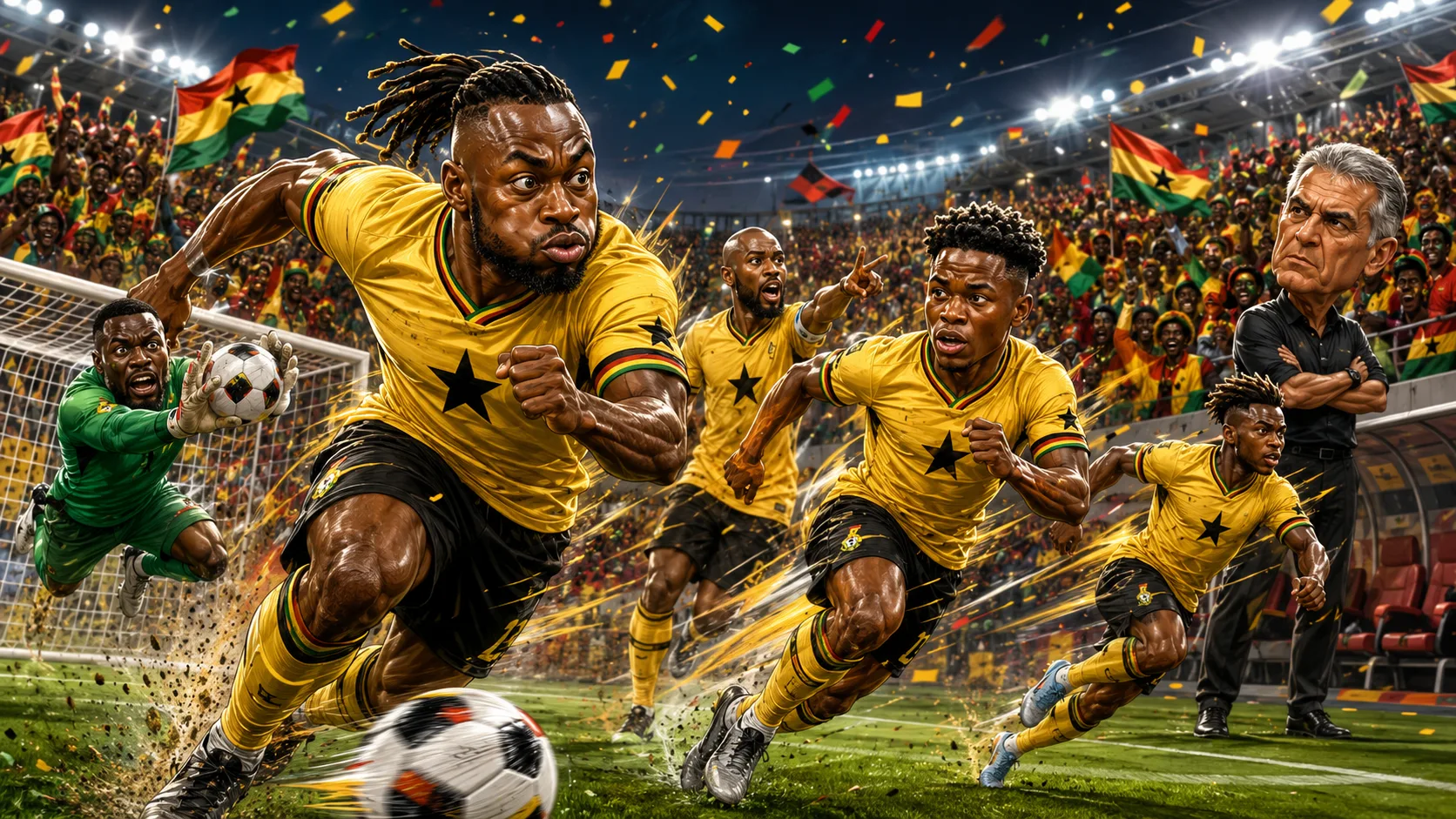
Ghana World Cup 2026 preview: Carlos Queiroz brings vast tournament experience to a talented but unsettled Black Stars side, with Antoine Semenyo expected to carry the main attacking threat in a difficult Group L featuring England, Croatia and Panama.
Ghana arrive in North America with the feel of a team standing between promise and uncertainty. The talent is there. The World Cup pedigree is there. The supporters will bring colour, rhythm and belief. Yet the Black Stars also enter the tournament with tactical questions, selection complications and a recent history that has been far less stable than their best moments suggest.
Queiroz has inherited a squad capable of troubling strong opponents, but he has had little time to turn Ghana into a fully settled unit. The warm-up match against Wales showed both sides of the problem. The first half looked too passive, too open and too disconnected in pressing. The second half was much more encouraging, with a coordinated mid-block, better midfield energy and improved protection for the full-backs. That second-half version is the one Ghana must take into the World Cup.
Group L is one of the tournament’s most intriguing sections. England and Croatia bring elite tournament experience, while Panama arrive with organisation and belief. Ghana’s opener against Panama may decide the mood of their campaign. Win that match, and the Black Stars can attack the England and Croatia fixtures with freedom. Slip up, and the group becomes immediately difficult.
Team Overview
Ghana’s World Cup 2026 squad has enough quality to be dangerous, but the team’s identity is still being shaped. Under Otto Addo, the Black Stars often lacked coherence. Defensive spacing could be loose, pressing triggers were unclear and the attacking structure did not always maximise the individual quality available. Queiroz has been brought in to restore order.
The Portuguese coach is unlikely to chase chaos. His international career has been built on structure, compactness and an ability to make underdog teams competitive against stronger nations. That could suit Ghana, especially in a group where they may not dominate the ball against England or Croatia.
The Black Stars have a mix of experienced senior players and exciting younger options. Jordan Ayew remains important for leadership and final-third intelligence, but Ghana’s biggest attacking hope now appears to be Semenyo. His club form has turned him into one of the most dangerous Ghanaian forwards of this generation, and his physical power gives the team a direct route to goal.
There is also a youthful midfield edge. Caleb Yirenkyi has forced himself into the conversation through energy, ball-carrying and timing, while Kwasi Sibo offers intensity and balance. If Ghana can combine that dynamism with the technical control of more established players, they can become difficult to play through.
The concern is goals. Ghana have often had talented attackers, but turning possession and transitions into enough clear chances has been a recurring issue. At a World Cup, chances are scarce and the margins are brutal. Semenyo’s finishing, Ayew’s intelligence and the wide players’ decision-making will decide whether Ghana become a real knockout contender or another team with potential left unused.
World Cup History
Ghana’s World Cup history is relatively recent compared with some African giants, but it is full of major moments. Their first appearance came in 2006, when the Black Stars reached the last 16 and introduced themselves as one of the tournament’s most exciting teams. That campaign helped establish a new global identity for Ghanaian football.
The peak came in 2010. Ghana reached the quarter-finals in South Africa and came within a penalty kick of becoming the first African nation to reach a World Cup semi-final. The dramatic defeat to Uruguay remains one of the most painful and famous matches in tournament history, but it also remains proof of Ghana’s ceiling when everything clicks.
Ghana returned in 2014 but struggled to repeat that run, and the tournament became clouded by off-field issues. In 2022, they were back again in Qatar, drawn into another emotionally charged group that included Uruguay. They beat South Korea in a thrilling match but failed to progress.
That history creates both pride and pressure. Ghana are not new to the World Cup. They have produced iconic players, memorable goals and one of Africa’s deepest tournament runs. But they have not yet returned to the heights of 2010, and each new generation is measured against that golden opportunity.
World Cup 2026 is therefore a chance to reconnect with that competitive identity. Ghana do not need to be favourites to be dangerous. Their best World Cup sides have combined physical intensity, technical midfielders, quick transitions and fearless attacking moments. Queiroz’s task is to recreate that balance with this squad.
Road to World Cup 2026
Ghana qualified for World Cup 2026 as one of Africa’s representatives after a campaign that contained enough quality to suggest a serious team, but also enough turbulence to keep expectations grounded. The Black Stars have rarely lacked players; the challenge has been making the pieces work consistently.
The qualifying cycle also came after a painful period for Ghanaian football. Missing the 2025 Africa Cup of Nations was a major blow for a country with such continental pedigree. That failure increased pressure on the national team and created a sense that the World Cup had to become a reset.
Queiroz’s arrival changed the tone. His message is based on discipline, seriousness and competitive responsibility. He is not a coach who accepts emotional football without structure. Ghana must run, fight and attack, but they must do it within a shape that protects the team.
The warm-up against Wales offered useful evidence. Ghana’s first half showed the danger of a leaky low block and disconnected pressing. Their second half showed how much better they can look when the midfield line moves together, the wingers support the full-backs and the team presses in synchronised waves.
Selection problems have complicated preparation. Thomas Partey’s situation has been a major talking point, particularly around availability for the opener in Canada. Mohammed Kudus’s absence through injury also removes one of Ghana’s most gifted creators. Those setbacks mean others must step forward quickly.
The Coach
Carlos Queiroz is one of the most experienced international coaches at World Cup 2026. His career includes work with Portugal, Iran, Egypt and other national teams, as well as high-level club experience with Real Madrid and Manchester United. Few managers understand tournament football, preparation pressure and underdog psychology better.
Queiroz is often associated with defensive organisation, but that should not be mistaken for negativity. His best teams are compact, disciplined and difficult to break down, but they also know how to transition quickly when space appears. For Ghana, that model could be useful because the squad has speed and physicality in wide areas.
He has described the Ghana job as one of the biggest challenges of his career, and it is easy to see why. Ghana expect success. The fanbase is demanding, the talent pool is strong and the historical benchmark of 2010 still hangs over every tournament.
His first major task is defensive clarity. Ghana cannot afford a back line that gets dragged around or a midfield that presses individually. Against England and Croatia, poor coordination would be punished. Against Panama, it could turn a winnable opener into a damaging result.
The second task is attacking balance. Ghana have several forwards competing for roles, including Semenyo, Jordan Ayew, Inaki Williams, Ernest Nuamah, Christopher Bonsu Baah, Kamaldeen Sulemana and Abdul Fatawu. Queiroz must choose not only the best individuals, but the best blend.
Star Player
Antoine Semenyo is Ghana’s star player heading into the tournament. His rise has given the Black Stars a forward with Premier League power, speed and confidence. In a squad searching for goals, he is the player most likely to change the shape of a match.
Semenyo’s international numbers have not always matched his club impact, but World Cup football offers him a huge stage to reshape that conversation. His movement across the front line, ability to attack space and willingness to shoot make him Ghana’s most dangerous attacking option.
He can operate from the left, through the middle or in a flexible forward role. That versatility is important for Queiroz because Ghana may need to change shape between matches. Against Panama, Semenyo could start as the main left-sided threat. Against England or Croatia, he may be used as a transition weapon when Ghana defend deeper.
His physical profile is also valuable. He can carry the ball under pressure, compete in duels and stretch defensive lines. Ghana need that because they may not always have the luxury of long possession spells.
If Semenyo finishes well, Ghana can qualify. If he is isolated or wasteful, their campaign becomes much harder. That is the level of responsibility he carries.
One to Watch
Caleb Yirenkyi is the one to watch. The young midfielder has drawn comparisons with Michael Essien because of his athletic profile, tackling, ball-carrying and ability to affect both halves of the pitch. Those comparisons are heavy, but they speak to the excitement around him.
Yirenkyi’s performance against Wales was important. His second-half introduction brought dynamism and urgency, and his goal underlined his ability to arrive at decisive moments. In a midfield that can sometimes look too static, his energy may be exactly what Ghana need.
He offers verticality. He can drive through pressure, win tackles and connect midfield with attack. Against strong opponents, that kind of player is essential because he can turn defensive pressure into forward momentum.
The question is whether Queiroz trusts him from the start. Tournament coaches often lean towards experience, but Ghana’s best balance may require younger legs. If Partey is unavailable or not fully sharp, Yirenkyi’s case becomes even stronger.
World Cups often create breakout stars. Yirenkyi has the profile to become one if Ghana make a run.
Unsung Hero
Benjamin Asare is Ghana’s unsung hero. Goalkeepers are often judged harshly when mistakes happen, but Asare’s arrival has helped settle a defence that previously looked too generous.
He is not yet viewed as a global name, and there are still questions around command of crosses at the highest level. But his quick reflexes, agility and distribution have given Ghana a more reliable base. A defence that had been conceding too often improved significantly once he became part of the structure.
For Queiroz, trust in the goalkeeper is vital. His teams depend on defensive concentration and low-error football. If Asare saves the shots he should save and distributes calmly under pressure, Ghana’s whole shape becomes more secure.
The opener against Panama could be especially important for him. Panama will test Ghana through transitions and set pieces, so Asare must manage his box with authority. Against England and Croatia, his shot-stopping may be called upon even more.
Tactical Style and What to Expect
Ghana are expected to play with a back four under Queiroz, a shift away from the back-three structures used previously. The likely base is a 4-2-3-1 or 4-3-3, depending on midfield availability and the opponent.
The double pivot is crucial. Queiroz needs ball-winning, athletic coverage and someone who can progress play calmly. Elisha Owusu, Kwasi Sibo and Yirenkyi all offer different profiles, while Partey’s situation complicates the picture. Without Partey, Ghana may lean more heavily on energy and structure rather than established midfield authority.
Out wide, the competition is strong. Nuamah and Bonsu Baah have pushed hard for minutes, while Semenyo is expected to hold one of the key attacking roles. Inaki Williams, Kamaldeen Sulemana and Abdul Fatawu remain options depending on the match state.
The pressing shape will be one of the most important tactical details. Ghana cannot afford isolated pressing. When one player jumps, the lines behind him must move together. If the press is late or disconnected, England and Croatia will play through it.
In attack, Ghana should be most dangerous when they win the ball and move quickly into wide areas. Semenyo’s speed, Nuamah’s directness and Carrasquilla-style creativity from Panama’s opponents are not relevant here; Ghana’s own success will come from rapid forward passes, diagonal runs and second-wave midfield support.
Strengths
- Power and pace in attack: Semenyo, Nuamah, Bonsu Baah, Williams, Sulemana and Fatawu give Ghana several explosive options.
- Experienced coach: Queiroz has managed at multiple World Cups and understands how to make teams compact and competitive.
- Midfield energy: Yirenkyi and Sibo can give Ghana intensity, pressing coverage and ball-carrying from central areas.
- Goalkeeper confidence: Asare has helped bring more stability to a back line that previously lacked assurance.
Weaknesses
- Goal-scoring uncertainty: Ghana’s attacking talent must translate into reliable finishing, which has not always happened.
- Preparation disruption: Partey’s availability issue and Kudus’s injury reduce midfield and creative options.
- Defensive coordination: The low block and pressing structure can still become disjointed if the lines do not move together.
- Difficult group: England, Croatia and Panama all pose different problems, leaving little margin for a slow start.
Probable Starting XI
Formation: 4-2-3-1
Benjamin Asare; Alidu Seidu, Alexander Djiku, Mohammed Salisu, Gideon Mensah; Caleb Yirenkyi, Kwasi Sibo; Ernest Nuamah, Jordan Ayew, Antoine Semenyo; Inaki Williams.
Queiroz has several alternatives. Elisha Owusu could start in midfield if he wants more defensive balance, Christopher Bonsu Baah is a strong wide option, while Kamaldeen Sulemana and Abdul Fatawu can provide pace from the bench. Partey’s availability may vary by venue, but Ghana must be ready to play without him.
Group Stage Fixtures
- Thursday, 18 June 2026: Ghana vs Panama — Toronto Stadium, Toronto — 03:00 MUT
- Wednesday, 24 June 2026: England vs Ghana — Boston Stadium, Foxborough — 00:00 MUT
- Sunday, 28 June 2026: Croatia vs Ghana — Philadelphia Stadium, Philadelphia — 00:00 MUT
Key Match
The key match is Ghana vs Panama. It is the opener and the fixture Ghana will view as the clearest route to three points. England and Croatia are stronger on paper, so Ghana cannot afford to waste the Panama game.
That does not make it easy. Panama are organised, physical and emotionally confident after a strong qualification campaign. They will defend compactly, break quickly and challenge Ghana’s patience.
For Ghana, the plan must be controlled aggression. They need to press well, protect against counters and get Semenyo into dangerous areas early. If they win, the group opens. If they draw or lose, the pressure before England becomes severe.
Can They Qualify From The Group?
Ghana can qualify from Group L, but it will require a sharp start and tactical discipline. The expanded format gives third-placed teams a possible route to the Round of 32, so Ghana do not necessarily need to finish above both England and Croatia. But they must avoid a damaging defeat to Panama.
Four points may be enough to keep them alive, especially if results elsewhere in the group are tight. That likely means beating Panama and taking something from England or Croatia. Three points could leave them dependent on goal difference and the wider third-place table.
Their best route is to win the opener, then approach England and Croatia with counter-attacking confidence. If Semenyo is in form and Yirenkyi gives the midfield enough energy, Ghana have the players to make one of the favourites uncomfortable.
However, the concerns are real. Defensive coordination must improve quickly, and the attack must be more ruthless than recent international returns suggest. Ghana’s ceiling is high, but their floor remains uncertain.
Prediction
Goal.mu prediction: Ghana to finish third in Group L and remain in contention for a Round of 32 place.
England and Croatia look like the favourites for the top two, but Ghana have enough quality to disrupt the section. The opener against Panama is decisive. Win it, and a knockout place becomes realistic. Fail to win, and the Black Stars may spend the rest of the group chasing damage limitation.
Semenyo’s form gives Ghana hope, Queiroz’s experience gives them structure and Yirenkyi’s energy gives them a fresh midfield spark. That should make them competitive, even if the group may ultimately prove just too demanding for automatic qualification.
Hot Stat
Ghana’s best World Cup finish remains the 2010 quarter-final, when they came closer than any African nation had ever come to reaching a men’s World Cup semi-final.
Final Analysis
Ghana’s World Cup 2026 campaign is full of possibility, but also full of questions. They have a respected coach, a dangerous forward in Semenyo, emerging midfield power through Yirenkyi and a goalkeeper who has helped restore confidence. That is enough to build a serious tournament plan.
The issue is whether the pieces can come together quickly. Queiroz has not had years to shape this side. He must solve pressing coordination, midfield balance and attacking efficiency under immediate tournament pressure.
Group L gives Ghana no time to warm into the competition. Panama must be treated as a must-win match, England will punish tactical errors and Croatia can control tempo if Ghana lose midfield discipline.
Still, the Black Stars should not be underestimated. Their World Cup history includes moments of African pride and near-history, and this squad has enough dynamism to create another memorable chapter if they find rhythm early.
For Goal.mu readers, Ghana look like a dangerous third-place contender: capable of beating Panama, capable of troubling a favourite, but still needing sharper structure and finishing to go deep.
World Cup 2026 Team Guide
🇬🇭 Ghana World Cup 2026 Fixtures, Squad & Predictions
Ghana bring World Cup pedigree and attacking talent to Group L. Their challenge is to turn individual quality into consistency after mixed recent tournament performances.
| Team | P | W | D | L | GF | GA | GD | Pts |
|---|---|---|---|---|---|---|---|---|
| 🏴 England | 3 | 2 | 1 | 0 | 6 | 2 | 4 | 7 |
| 🇭🇷 Croatia | 3 | 2 | 0 | 1 | 5 | 5 | 0 | 6 |
| 🇬🇭 Ghana | 3 | 1 | 1 | 1 | 2 | 2 | 0 | 4 |
| 🇵🇦 Panama | 3 | 0 | 0 | 3 | 0 | 4 | -4 | 0 |
World Cup 2026
Fixtures in Mauritius Time
All times below are shown in Mauritius Time (MUT).
Thursday 18 June 2026
🇬🇭 Ghana 1 - 0🇵🇦 Panama
Group L • Toronto, Canada
Toronto StadiumWednesday 24 June 2026
🏴 England 0 - 0🇬🇭 Ghana
Group L • Foxborough, USA
Foxborough StadiumSunday 28 June 2026
🇭🇷 Croatia 2 - 1🇬🇭 Ghana
Group L • Philadelphia, USA
Philadelphia StadiumSaturday 4 July 2026
🇨🇴 Colombia 1 - 0🇬🇭 Ghana
Round of 32 • Kansas City, USA
GEHA Field at Arrowhead StadiumGoal.mu Predictions
World Cup 2026 Predictions
🇲🇽 Mexico vs 🇿🇦 South Africa
🇰🇷 South Korea vs 🇨🇿 Czech Republic
🇨🇦 Canada vs 🇧🇦 Bosnia & Herzegovina
🇺🇸 USA vs 🇵🇾 Paraguay
🇶🇦 Qatar vs 🇨🇭 Switzerland
🇧🇷 Brazil vs 🇲🇦 Morocco
🇭🇹 Haiti vs 🏴 Scotland
🇦🇺 Australia vs 🇹🇷 Turkey
The content provided in this article is intended solely for informational and entertainment purposes. Betting and gambling involve significant risks, including the potential loss of the principal amount wagered. Readers should be aware of their local regulations and laws concerning online betting and gambling. Always gamble responsibly, knowing that the outcomes are unpredictable and can lead to financial losses.If you or someone you know may have a gambling problem, please seek help. Many organizations provide resources and support for individuals struggling with gambling addiction. Remember, the best bet is always a well-informed decision.Never gamble with funds that are essential for your daily life, and always set limits to ensure you’re not gambling more than you can afford to lose. The thrill of the bet should never overshadow the potential consequences of loss. Stay safe, informed, and gamble responsibly.