
France at World Cup 2026: Team Preview, History, Key Players & Prediction
France at World Cup 2026: Team Preview, History, Key Players & Prediction
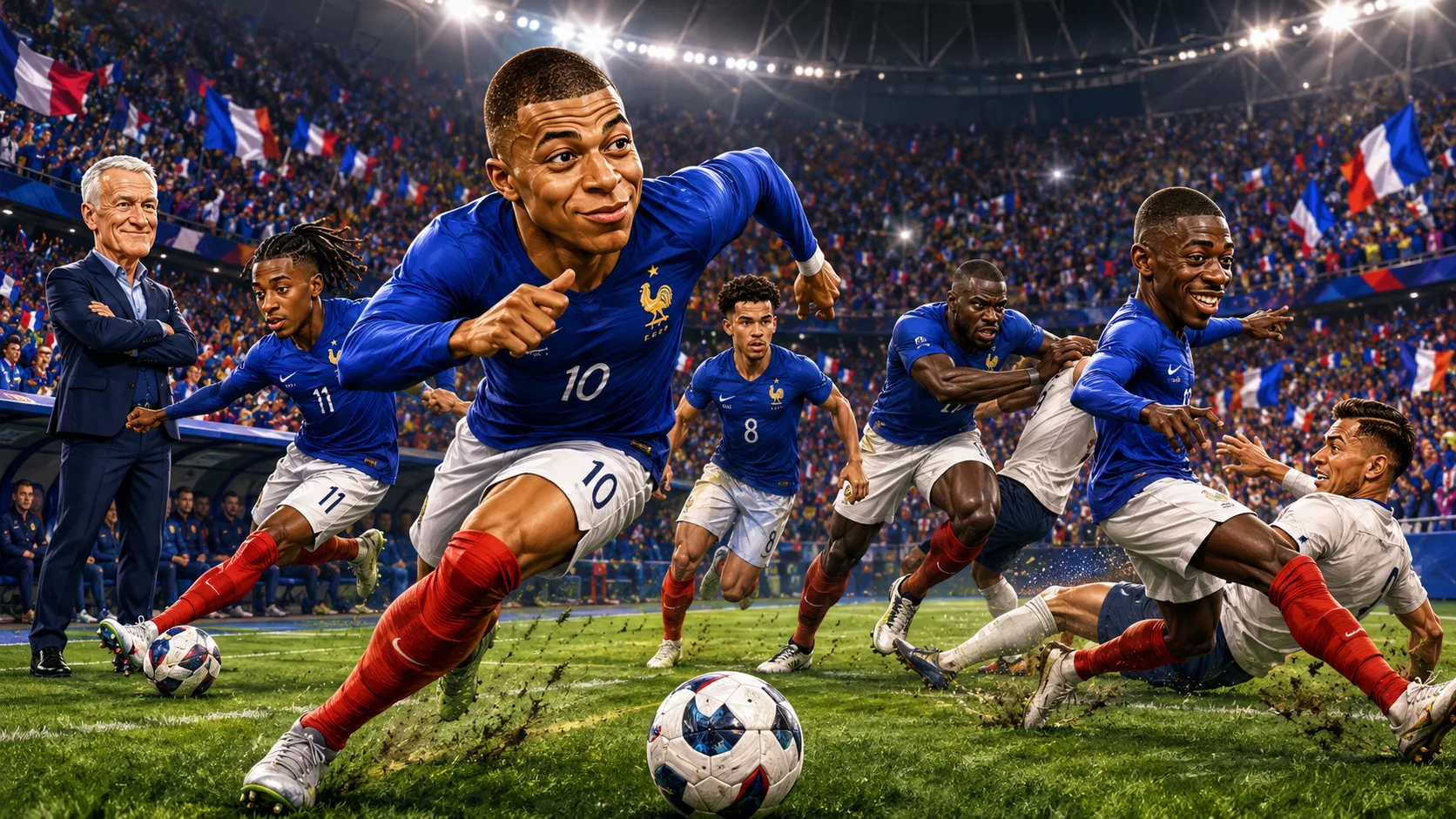
France World Cup 2026 preview: Didier Deschamps takes Les Bleus into his final tournament with Kylian Mbappe leading a frightening attack, but the old question remains whether France will release the handbrake or trust the controlled pragmatism that has carried them to the top of international football.
France do not arrive in North America searching for respect. They arrive carrying expectation. Recent tournament history has made them a permanent reference point: champions in 2018, runners-up in 2022, European Championship semi-finalists in 2024 and still one of the most complete squads in the game. Yet there is always a tension around this team. France have the attacking talent to overwhelm almost anyone, but Deschamps has built his empire on control, balance and defensive security.
That tension may define their World Cup 2026 campaign. Kylian Mbappe remains the headline act, Ousmane Dembele brings Ballon d’Or-level status, Michael Olise offers invention, Desire Doue and Bradley Barcola add depth, and Warren Zaire-Emery represents the new midfield generation. France can look devastating when the game opens up. They can also look conservative when Deschamps decides tournament survival matters more than entertainment.
Group I gives them an immediate test of range. Senegal are physically powerful and experienced, Iraq bring emotion and discipline, while Norway have Erling Haaland and Martin Odegaard waiting in the final group match. France should qualify, but this is not a group where they can drift through three matches at half-speed. They will need rhythm quickly.
Team Overview
France remain one of the deepest and most talented teams at World Cup 2026. Their squad contains elite players in every line, from Mike Maignan in goal to William Saliba, Dayot Upamecano and Jules Kounde in defence, Aurelien Tchouameni and Warren Zaire-Emery in midfield, and a forward line capable of terrifying any opponent.
The central question is not whether France have enough quality. They clearly do. The question is whether Deschamps can turn the attacking options into a balanced, repeatable system. Since Olivier Giroud’s retirement from international football, France have been searching for a slightly different reference point in attack. Mbappe now operates more centrally, and that changes the structure around him.
At their most conservative, France can appear heavy. They protect the defensive block, choose cautious passing lanes and rely on moments from elite individuals. At their best, they blend that defensive base with explosive transitions, wide combinations and ruthless finishing. The gap between those versions will decide whether they simply go deep again or win the tournament.
The March friendlies in the United States suggested a more expansive idea. France scored freely and looked less predictable, with Deschamps publicly acknowledging the desire to make his side harder to read. But tournament football has a way of pulling pragmatic managers back towards what they trust most. For Deschamps, that means defensive solidity first, attacking expression second.
That formula has brought huge success. It has also brought criticism. Some supporters want France to play with more adventure because the talent is so obvious. Deschamps has never been overly concerned with aesthetic judgement. He wants to win. If that means France suffer without the ball or narrow the match into a tactical arm-wrestle, he will accept it.
World Cup History
France have one of the richest World Cup histories in modern football. Their first triumph came on home soil in 1998, when Zinedine Zidane’s headers and a 3-0 final victory over Brazil created one of the defining nights in French sport. That team changed the country’s football identity and established France as a true global power.
The second star arrived in Russia in 2018. Deschamps, who had captained the 1998 champions, became the manager who led a new generation to glory. Mbappe exploded onto the world stage, Antoine Griezmann orchestrated the attack, N’Golo Kante covered enormous ground, Paul Pogba provided authority and Raphael Varane led the defence. France beat Croatia 4-2 in the final and looked like a team built to remain at the top for years.
They nearly repeated the feat in Qatar in 2022. Despite injuries and squad disruption, France reached another final, where Mbappe produced one of the greatest individual performances in World Cup history with a hat-trick against Argentina. Les Bleus eventually lost on penalties, but the campaign reinforced their status as a tournament machine.
There have also been painful chapters. France reached the 2006 final but lost to Italy on penalties after Zidane’s red card. Their 2010 campaign collapsed amid internal chaos. Their 2002 title defence ended in group-stage humiliation. These lows explain why Deschamps values control so much. He understands how quickly talent can unravel without structure.
France’s World Cup record is therefore a story of genius and volatility, triumph and scars. The current generation are heirs to both. They know the standard is not merely to compete; it is to reach semi-finals, finals and title matches. Anything less than a deep run will be viewed as disappointment.
Road to World Cup 2026
France qualified as UEFA Group D winners, maintaining their position among Europe’s strongest national teams. The campaign was not always spectacular, but it was effective. That has been the Deschamps way for more than a decade: protect the structure, control risk and let elite players decide matches.
The defensive record was again important. France did not simply rely on Mbappe or Dembele to solve games. They limited opponents, managed difficult phases and rarely allowed matches to become uncontrolled. That matters at a World Cup, where one reckless 15-minute spell can ruin four years of preparation.
At the same time, there was recognition inside the camp that France needed to become more flexible in attack. Euro 2024 had shown the limits of excessive caution. France reached the semi-finals, but goals from open play were scarce, and the team sometimes looked too dependent on set pieces, penalties or opposition mistakes.
The response in the following cycle was to test more attacking relationships. Olise’s inclusion gives the team craft between the lines and on the right. Dembele offers dribbling, speed and unpredictability. Mbappe remains the finishing reference. Barcola, Doue, Cherki and Thuram give Deschamps multiple ways to refresh the attack without losing quality.
That depth makes France dangerous, but it also creates selection dilemmas. Deschamps must decide which attacking balance gives Mbappe the most support without leaving the midfield exposed. He must also decide how much trust to place in younger players when knockout football arrives.
The Coach
Didier Deschamps has become the gold standard for international tournament management. He may not always produce the football neutrals want to watch, but his record is extraordinary. A World Cup winner as a player and manager, a Euros finalist, a World Cup runner-up and a serial semi-final presence, he has mastered the demands of short-format elite competition.
His style is built on pragmatism. Deschamps cares about balance, dressing-room harmony, defensive reliability and players who understand sacrifice. He has little patience for the argument that France should entertain more simply because they possess gifted attackers.
That does not mean he is tactically rigid. Deschamps has adjusted systems across his reign, used different midfield profiles and reshaped the attack around changing personnel. But his principles are consistent. France must remain compact. France must not lose emotional control. France must make big moments count.
The criticism has followed him for years. Some believe France should dominate matches more beautifully. Deschamps’s response has always been simple: results justify the method. That confidence comes from trophies, finals and repeated proof that his approach works when pressure is at its highest.
World Cup 2026 is expected to be his final tournament with Les Bleus. That gives this campaign a legacy edge. Deschamps does not need validation, but winning another World Cup would place him in an even more rare managerial category. He is unlikely to abandon his instincts now. France may expand in certain matches, but when danger rises, expect Deschamps to trust the structure that has defined his reign.
Star Player
Kylian Mbappe remains the star. He is no longer simply the explosive teenager who destroyed defensive lines in 2018. He has developed into a central scorer, a captain, a global figure and the player around whom France’s attacking idea is built.
Mbappe’s greatest strength is that he changes the geometry of a match. Defences drop deeper because of his speed. Centre-backs hesitate because of his acceleration. Full-backs tuck in because one pass behind the line can become a goal. Even when he is not touching the ball, he alters how opponents defend.
His World Cup record is already exceptional. He scored in the 2018 final, produced a hat-trick in the 2022 final and continues to chase individual records that would place him among the greatest tournament players ever. France do not just need his goals; they need his authority.
The challenge is balance. When Mbappe plays as a No 9, France lose the traditional target-man profile that Giroud provided. They gain speed, finishing and individual brilliance, but they must make sure runners and creators are positioned around him properly. Olise, Dembele and Griezmann-style connectors of the past have shown why support movements matter.
If Mbappe is sharp, France can beat anyone. If opponents isolate him or force him into low-percentage actions, the system must still function around him. That is the puzzle Deschamps must solve.
One to Watch
Warren Zaire-Emery is the player to watch because he represents both the present and the future of France’s midfield. Still young, already experienced at elite club level and technically secure under pressure, he gives Deschamps a profile that can help modernise the team without losing intensity.
Zaire-Emery’s early France story has not been a straight line. He burst into senior international football as a teenager, then had to deal with injuries, form fluctuations and fierce competition. His response has been impressive. He has re-established himself through maturity, tactical discipline and the ability to play in demanding midfield structures.
His versatility is valuable. He can operate as an interior midfielder, provide pressing energy, help in build-up and even cover wider or deeper zones if required. That matters for a France side searching for the right blend between control and attacking freedom.
At World Cup 2026, he may not start every decisive match, but he can become increasingly important as the tournament develops. If France need more legs in midfield, more technical security or a fresh solution to a tactical problem, Zaire-Emery could be the answer.
Unsung Hero
Dayot Upamecano is the unsung hero of this France squad. William Saliba receives deserved praise for his development and elegance, but Upamecano’s consistency and physical authority are crucial to the national team’s defensive base.
Upamecano has added composure to his game. Earlier in his career, he was sometimes associated with high-profile errors, but he has matured into a more reliable centre-back. He remains fast, strong and aggressive in duels, but now reads danger with greater calm.
That matters because France’s attacking expansion depends on centre-backs who can defend large spaces. If Deschamps allows more players forward, the central defenders must handle counters, aerial duels and one-v-one moments. Upamecano gives France that security.
He also helps France progress the ball. He can carry possession through the first line and play firm passes into midfield. Against teams who sit deep, that can be important because France need defenders who do more than recycle the ball sideways.
If France go deep, Mbappe and Dembele may dominate the headlines. But Upamecano’s ability to keep the back line stable could be just as decisive.
Tactical Style and What to Expect
France’s tactical style is a controlled hybrid. They can counter-attack at devastating speed, dominate possession in phases and defend in a disciplined medium block. Deschamps does not need his side to control every minute with the ball. He wants them to control the danger.
The likely base is a 4-2-3-1 or 4-3-3 depending on opponent and selection. Maignan starts in goal if fit. Kounde offers security at right-back, while Theo Hernandez or Lucas Hernandez can change the left-side profile. Saliba and Upamecano provide speed and physical authority at centre-back.
In midfield, Tchouameni is the anchor. His positioning allows France to cover transitions and protect central areas. Rabiot, Kone, Kante or Zaire-Emery can be used depending on whether Deschamps wants running power, control or experience.
The attacking line is where the intrigue sits. Mbappe is the reference point. Dembele can play wide or inside. Olise offers left-footed craft and combination play. Doue, Barcola, Cherki and Thuram give France different forms of directness, creativity and penalty-box support.
France may try to be less predictable, but the defensive backbone will remain. They will not become reckless. The most realistic evolution is a side that presses with more ambition in selected matches, combines faster around Mbappe and uses Olise or Dembele to create more central overloads.
Strengths
- Elite attacking talent: Mbappe, Dembele, Olise, Doue, Barcola, Cherki and Thuram give France one of the deepest forward groups in the tournament.
- Tournament experience: Deschamps, Mbappe, Hernandez, Kounde, Saliba and other senior figures understand knockout pressure.
- Defensive structure: France rarely abandon shape, and their centre-backs have the speed to defend large spaces.
- Squad depth: France can change matches from the bench without a dramatic drop in quality.
Weaknesses
- Attacking balance: Without Giroud’s traditional focal point, France must ensure Mbappe receives the right support as a central striker.
- Risk of caution: Deschamps’s pragmatism can make France passive if they retreat too early or play too slowly.
- Right-back balance: Selection on the right side of defence can affect how much attacking width France can safely create.
- High expectations: Anything short of a semi-final will feel underwhelming for a squad with this much talent.
Probable Starting XI
Formation: 4-2-3-1
Maignan; Kounde, Saliba, Upamecano, Theo Hernandez; Tchouameni, Rabiot; Dembele, Olise, Barcola; Mbappe.
There are several alternatives. Lucas Hernandez could start for greater defensive control, N’Golo Kante may be used when Deschamps wants experience and ball-winning security, while Zaire-Emery, Doue, Cherki and Thuram are strong options depending on opponent and match state.
Group Stage Fixtures
- Tuesday, 16 June 2026: France vs Senegal — New Jersey Stadium, East Rutherford — 23:00 MUT
- Tuesday, 23 June 2026: France vs Iraq — Philadelphia Stadium, Philadelphia — 01:00 MUT
- Friday, 26 June 2026: Norway vs France — Boston Stadium, Foxborough — 23:00 MUT
Key Match
The key match is France vs Senegal. Opening games set the emotional tone, and Senegal are too strong to be treated as a routine opponent. They have power, pace, tournament experience and the ability to turn the match into a physical contest.
If France win the opener, they will be in a strong position before facing Iraq and Norway. If they draw or lose, pressure immediately rises, especially with Haaland waiting in the final group match.
Deschamps will want control against Senegal, but he will also need enough attacking intent. A slow, conservative start could invite pressure and create unnecessary tension. The opener is the match where France can prove whether the more expansive version of the team is ready for tournament football.
Can They Qualify From The Group?
France should qualify from Group I. Their squad quality, tournament experience and tactical reliability make them favourites to finish top. But this is not a soft group.
Senegal can challenge physically and tactically. Norway have two elite match-winners in Haaland and Odegaard. Iraq may be outsiders, but emotional tournament sides can be difficult if they are allowed to stay in matches. France must therefore approach the group with seriousness from the first whistle.
The most likely scenario is France finishing first. Their range of attacking options should be too much across three matches, and their defence is good enough to limit most opponents. However, they cannot afford attacking wastefulness or excessive caution. In an expanded format, qualification may be forgiving, but seeding and knockout route still matter.
Winning the group would also send a message. France are expected to go deep; topping a difficult section would confirm that Deschamps’s final squad has both quality and competitive edge.
Prediction
Goal.mu prediction: France to finish first in Group I and reach at least the semi-finals, with a realistic chance of winning the World Cup if the attack finds the right balance around Mbappe.
The ceiling is obvious. France have enough talent to beat any team in the tournament. The concern is not quality; it is fluency. If Deschamps solves the attacking shape and avoids over-caution, Les Bleus can win a third World Cup. If the team becomes too conservative, they may still go far, but their margin for error will shrink.
Hot Stat
France have reached three of the last four men’s World Cup finals they have played since 1998, winning two titles and losing one final on penalties.
Final Analysis
France enter World Cup 2026 as one of the strongest teams in the tournament, but also one of the most fascinating. They are not a mystery in terms of quality; they are a mystery in terms of expression.
Deschamps has built a winning machine through caution, discipline and clarity. That approach has been criticised, but it has also delivered more than most nations could dream of. Now, with his final tournament approaching, he must decide how much freedom to give a forward line that looks capable of overwhelming opponents.
Mbappe remains the decisive figure, but this France team is no longer only about him. Dembele, Olise, Barcola, Doue, Cherki, Thuram and Zaire-Emery offer layers of talent. Saliba and Upamecano provide the defensive base. Tchouameni gives midfield security. Maignan brings authority in goal.
The ingredients are there for another final run. The challenge is combining them without losing the cold efficiency that has defined the Deschamps era.
France may not always be beautiful. They may not always be open. But they know how to survive, manage pressure and win knockout matches. In World Cup football, that remains one of the most valuable qualities of all.
World Cup 2026 Team Guide
🇫🇷 France World Cup 2026 Fixtures, Squad & Predictions
France arrive as one of the strongest squads in world football and a proven tournament machine. Group I is demanding, but Les Bleus will still be among the favourites to win the World Cup.
| Team | P | W | D | L | GF | GA | GD | Pts |
|---|---|---|---|---|---|---|---|---|
| 🇳🇴 Norway | 1 | 1 | 0 | 0 | 4 | 1 | 3 | 3 |
| 🇫🇷 France | 1 | 1 | 0 | 0 | 3 | 1 | 2 | 3 |
| 🇸🇳 Senegal | 1 | 0 | 0 | 1 | 1 | 3 | -2 | 0 |
| 🇮🇶 Iraq | 1 | 0 | 0 | 1 | 1 | 4 | -3 | 0 |
World Cup 2026
Fixtures in Mauritius Time
All times below are shown in Mauritius Time (MUT).
Tuesday 16 June 2026
🇫🇷 France 3 - 1 🇸🇳 Senegal
Group I • New Jersey, USA
TBCTuesday 23 June 2026
🇫🇷 France vs 🇮🇶 Iraq
Group I • Philadelphia, USA
Philadelphia StadiumFriday 26 June 2026
🇳🇴 Norway vs 🇫🇷 France
Group I • Foxborough, USA
Foxborough StadiumGoal.mu Predictions
World Cup 2026 Predictions
🇲🇽 Mexico vs 🇿🇦 South Africa
🇰🇷 South Korea vs 🇨🇿 Czech Republic
🇨🇦 Canada vs 🇧🇦 Bosnia & Herzegovina
🇺🇸 USA vs 🇵🇾 Paraguay
🇶🇦 Qatar vs 🇨🇭 Switzerland
🇧🇷 Brazil vs 🇲🇦 Morocco
🇭🇹 Haiti vs 🏴 Scotland
🇦🇺 Australia vs 🇹🇷 Turkey
The content provided in this article is intended solely for informational and entertainment purposes. Betting and gambling involve significant risks, including the potential loss of the principal amount wagered. Readers should be aware of their local regulations and laws concerning online betting and gambling. Always gamble responsibly, knowing that the outcomes are unpredictable and can lead to financial losses.If you or someone you know may have a gambling problem, please seek help. Many organizations provide resources and support for individuals struggling with gambling addiction. Remember, the best bet is always a well-informed decision.Never gamble with funds that are essential for your daily life, and always set limits to ensure you’re not gambling more than you can afford to lose. The thrill of the bet should never overshadow the potential consequences of loss. Stay safe, informed, and gamble responsibly.