Croatia World Cup 2026 Guide, Fixtures, Results & History
Croatia at World Cup 2026: Team Preview, History, Key Players & Prediction
Croatia World Cup 2026 preview: Zlatko Dalic’s experienced Vatreni return for another major tournament push, with 40-year-old Luka Modric still pulling the strings and a new defensive generation led by Josko Gvardiol and Luka Vuskovic trying to extend the country’s remarkable World Cup story.
Croatia have spent the past decade turning football logic upside down. For a nation of modest population, their World Cup record is extraordinary: finalists in 2018, third in 2022 and still a side nobody wants to meet in a tight knockout match. Now they arrive in North America with familiar strengths, familiar doubts and one major question. Can the old guard produce one final run?
The squad is full of experience, but that experience comes with an obvious physical concern. Modric is now 40. Ivan Perisic is 37. Andrej Kramaric is approaching the late stage of his international career. Mateo Kovacic remains vital, but has also had fitness issues. Croatia still know how to control rhythm, suffer in difficult matches and stay alive longer than opponents expect. The test is whether they can do it again in a faster, younger tournament.
Group L gives them no easy path. England are strong contenders, Ghana have dangerous athleticism and Panama are organised enough to punish complacency. Croatia should still believe they can qualify, but they cannot rely only on reputation. They need clear structure, midfield balance and sharper attacking output than they sometimes produced in qualifying.
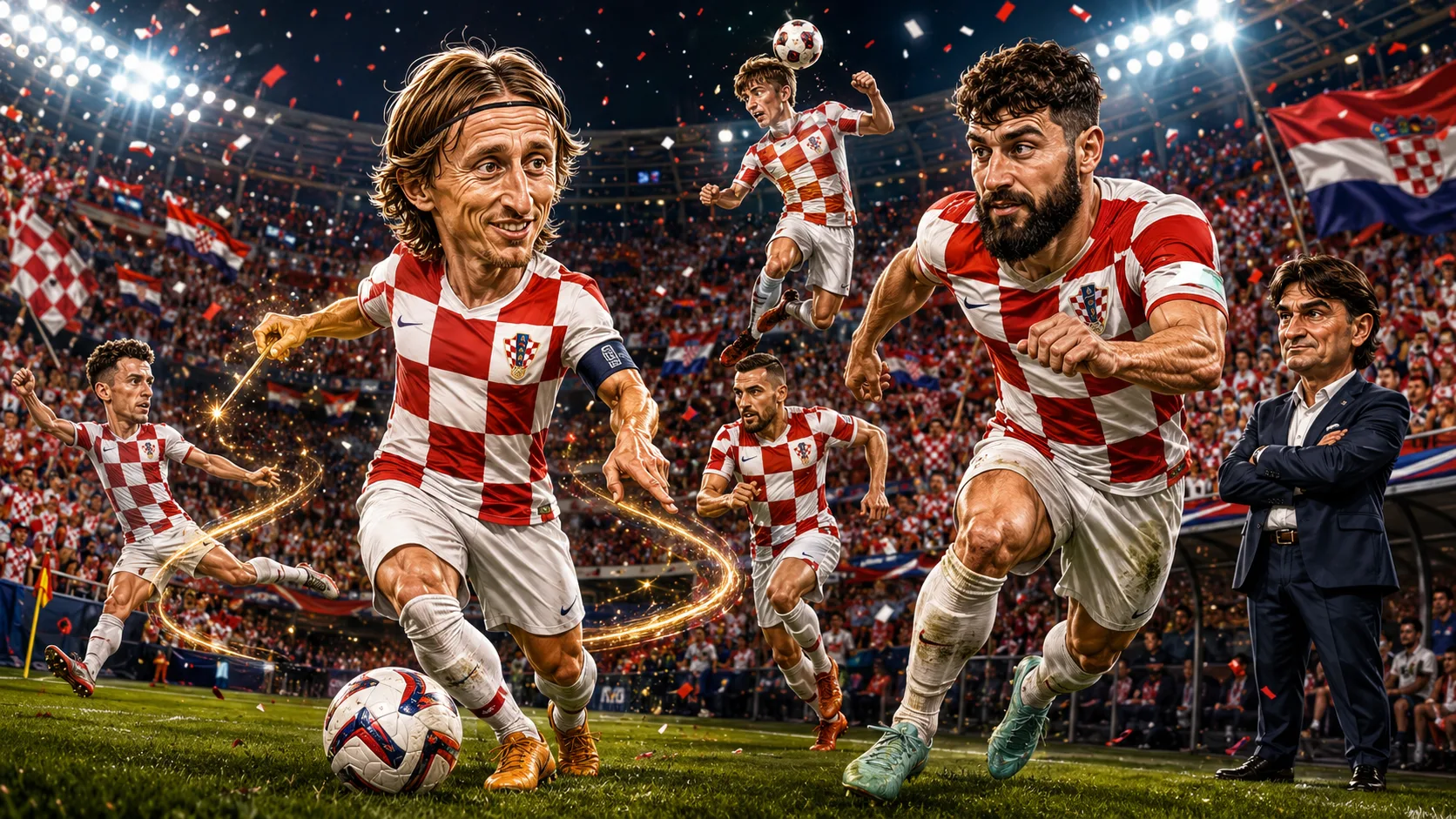
Team Overview
Croatia enter World Cup 2026 as one of the most respected tournament teams in international football. Their achievements under Dalic have changed expectations. They are no longer seen as a romantic outsider hoping for a good draw; they are judged as a side that can go deep, manage pressure and eliminate bigger football nations through intelligence and resilience.
The identity remains built around midfield control. Modric, Kovacic, Mario Pasalic, Martin Baturina, Petar Sucic and Nikola Vlasic give Dalic a range of options, but the emotional and tactical centre is still Modric. Croatia are at their best when they can slow the game, circulate possession and force opponents to chase the ball at their rhythm.
There is also a defensive transition happening. Gvardiol has become one of the world’s most complete defenders, comfortable at centre-back or left-back, while Vuskovic represents the next major centre-back prospect. Josip Stanisic, Josip Sutalo, Marin Pongracic and Duje Caleta-Car offer depth, but Dalic must find the right balance between experience and mobility.
In attack, the questions are sharper. Croatia can still create through combination play and wide deliveries, but they do not possess a natural world-class No 9 in the mould of the tournament’s most feared strikers. Kramaric offers intelligence and finishing, Ante Budimir gives penalty-box presence, and Perisic still brings delivery and experience, yet Croatia may need goals from several sources rather than one reliable scorer.
The team’s emotional strength should not be underestimated. Croatia have repeatedly shown they can survive extra time, penalties, hostile atmospheres and poor spells. But World Cup 2026 may demand more speed and more vertical threat. Their best version can still frustrate elite opponents. Their worst version could look too old if matches become open.
World Cup History
Croatia’s World Cup history is one of the most impressive modern stories in the competition. Since independence, they have produced results that far exceed the size of the country and the depth of the domestic football market.
The first great chapter came in 1998. Croatia, making their debut as an independent nation, reached the semi-finals in France and finished third. Davor Suker won the Golden Boot, Robert Prosinecki and Zvonimir Boban led a golden generation, and the famous red-and-white checks became one of the tournament’s iconic images.
After mixed campaigns in the years that followed, Croatia returned to the highest level in 2018. Dalic’s side reached the final in Russia after a series of emotionally draining knockout matches. They beat Denmark and Russia on penalties, defeated England in extra time and eventually lost to France in the final. Modric won the Golden Ball, and Croatia’s run became a national sporting landmark.
Many expected a decline before Qatar 2022, but Croatia proved again that tournament intelligence can outlast assumptions. They reached another semi-final, eliminating Brazil on penalties before losing to Argentina. They then beat Morocco to finish third, adding bronze to the silver from four years earlier.
That record has set an almost impossible bar. Croatia are now expected to compete deep into tournaments, even when the squad is ageing. World Cup 2026 may be the final stage for several icons, making this campaign feel like a farewell tour with genuine competitive ambition.
Road to World Cup 2026
Croatia qualified with relative comfort, topping their group and securing first place before the final matchday. Czechia provided the only serious resistance and were the only opponent to prevent Croatia from taking maximum points in every meeting, but Dalic’s side generally controlled the campaign.
The qualifying route also gave Dalic room to experiment. He tested different structures, deepened his player pool and looked at options beyond his most trusted core. That experimentation included ideas around a back three, although the manager later suggested strongly that he did not want to repeat that approach after qualifying.
The picture changed again in March friendlies, when Dalic revisited the three-at-the-back system against Colombia and Brazil. The results were mixed: a win over Colombia and a defeat to Brazil. That testing period left the impression that a back three could remain a Plan B, but not the main tournament plan.
The likely World Cup base is still a back four, either in a 4-3-3 or 4-2-3-1. That has been the constant across Dalic’s long reign. It gives Croatia familiarity, midfield control and natural roles for their senior players.
The return to fitness of Gvardiol and Kovacic is particularly important. Croatia’s entire structure looks different when those two are available. Gvardiol gives defensive authority and ball progression. Kovacic gives Modric freedom, dribbling security and the ability to connect phases of play. Without them, Dalic’s system becomes more vulnerable.
The Coach
Zlatko Dalic has become one of the most successful managers in Croatia’s history. In a football culture where coaches can be judged harshly and replaced quickly, surviving almost a decade in the job is remarkable. Doing so while reaching a World Cup final and then another semi-final makes him practically untouchable.
Dalic’s biggest strength is tournament management. He understands Croatia’s emotional rhythm, trusts his senior leaders and knows how to keep the team calm in pressure matches. Croatia do not often panic under him. They believe they can survive difficult spells and still find a route back into the game.
He is also loyal. That loyalty has helped create stability, but it creates selection questions now that several key players are older. Dalic must decide how far to lean on the veterans and when to give younger players larger responsibility.
His tactical preference remains a back four with a strong midfield platform. The brief experiments with a back three suggest he wants flexibility, but Croatia’s strongest identity still comes from midfield control and measured build-up rather than radical structural change.
World Cup 2026 could be the final chapter of his Croatia tenure. His contract situation has been a sensitive topic, but his legacy is already secure. The only question is whether he can produce one last major run with the group that has defined his era.
Star Player
Luka Modric remains Croatia’s star player, even at 40. It is extraordinary that a team with multiple elite footballers still revolves around a midfielder who made his full international debut two decades ago, but Modric has spent his entire career defying the normal rules of age, size and tempo.
He is not the same player who dominated Champions League midfields at his physical peak, but he still reads the game faster than almost everyone around him. His first touch creates time. His body shape opens passing lanes. His leadership calms Croatia when matches become tense.
Modric’s role may need careful management. He cannot be expected to run every match at maximum intensity for 90 minutes in a congested tournament. Dalic must protect him with the right midfield partners and use his minutes intelligently.
When Croatia have possession, Modric still dictates tempo. When they defend, his positioning helps the block stay connected. In moments of pressure, teammates still look to him. That influence is why he remains the central figure.
World Cup 2026 may push him beyond 200 caps, another staggering milestone in an international career already full of records. If Croatia make another deep run, it will almost certainly have Modric’s fingerprints all over it.
One to Watch
Luka Vuskovic is the one to watch. The young centre-back has been talked about in Croatia for years because of his rare blend of size, technical quality, aerial dominance and personality.
Vuskovic is not just a defender who clears the ball. He can progress possession, pick passes and attack set pieces. He has been a leader in several age groups and has shown the confidence of a player who expects to belong at the highest level.
The question is whether he is ready for the World Cup stage. Croatia believe he is. Dalic has seen enough to trust him, and with the squad evolving, Vuskovic could become part of the defensive future arriving sooner than expected.
Playing alongside or near Gvardiol would give Croatia an exciting defensive foundation. Gvardiol’s experience at elite level and Vuskovic’s emerging authority could help smooth the transition from the old core to the next generation.
If Vuskovic starts and performs well, he could leave North America as one of the breakout defenders of the tournament.
Unsung Hero
Mateo Kovacic is Croatia’s unsung hero. That may sound strange for a player with elite club pedigree, but within the national-team conversation he has often lived in Modric’s shadow. His importance becomes clearest when he is missing.
Kovacic gives Croatia something few midfielders can provide: press resistance through carrying. He can receive under pressure, glide away from markers and connect defence to attack. That ability is vital because it stops Croatia from becoming too dependent on Modric’s passing alone.
He also protects Modric. When Kovacic is fit and sharp, Modric can manage his energy better, choose his moments and operate in more dangerous creative zones. Without Kovacic, Croatia may need to adjust the formation or add extra midfield protection.
Dalic’s tactical choices often depend on Kovacic’s condition. If he is available, Croatia can trust a 4-3-3 with greater confidence. If he is not at full level, a 4-2-3-1 or even a more conservative structure may become necessary.
For Croatia to reach the knockouts and compete with England or other elite sides, Kovacic must be close to his best.
Tactical Style and What to Expect
Croatia’s likely tactical base is a 4-3-3, although a 4-2-3-1 remains possible depending on Kovacic’s fitness and the opponent. The aim is familiar: control the ball, dictate tempo, avoid chaos and trust midfield quality to create enough attacking platforms.
The midfield is the heart of everything. Modric controls rhythm, Kovacic carries through pressure and a third midfielder such as Mario Pasalic, Nikola Moro, Martin Baturina or Petar Sucic can provide balance. Against more physical teams, Dalic may choose extra energy. Against technical teams, he may prioritise control.
In defence, Gvardiol’s role is crucial. If he plays left-back, Croatia gain ball progression and defensive power on that side. If he plays centre-back, they gain a dominant central presence. Stanisic on the right offers reliability, while Sutalo, Pongracic, Vuskovic or Caleta-Car can compete for central roles.
In attack, Croatia may not overwhelm teams with pace, so their final-third execution must be precise. Perisic can still deliver dangerous crosses, Kramaric can drift intelligently, Budimir can attack the box and Baturina or Vlasic can provide creativity between the lines.
The main danger is tempo. If matches become stretched, Croatia’s older players may be forced into repeated sprints and recovery runs. Dalic will therefore want control, compactness and patient possession. Croatia are at their most comfortable when the match is played at their rhythm, not the opponent’s.
Strengths
- Elite tournament experience: Croatia know how to survive pressure, manage knockout tension and stay calm in hostile match states.
- Midfield intelligence: Modric and Kovacic give Croatia control, press resistance and the ability to dictate tempo.
- Defensive quality: Gvardiol, Stanisic and Vuskovic give Dalic a strong mix of established class and emerging talent.
- Winning mentality: Recent World Cup silver and bronze medals have created a squad culture that expects to compete deep into tournaments.
Weaknesses
- Age profile: Several key players are in their 30s or older, raising questions about physical durability across a long tournament.
- Limited pace in transition: Croatia can struggle if opponents force them into open, end-to-end games.
- Goal-scoring reliability: The attack lacks a guaranteed elite tournament striker, so goals may need to come from several sources.
- Dependence on key midfielders: If Modric or Kovacic are below their best, Croatia’s whole rhythm can suffer.
Probable Starting XI
Formation: 4-3-3
Dominik Livakovic; Josip Stanisic, Luka Vuskovic, Josko Gvardiol, Borna Sosa; Luka Modric, Mateo Kovacic, Mario Pasalic; Ivan Perisic, Andrej Kramaric, Martin Baturina.
Dalic could adjust depending on opponent. Ante Budimir may start if Croatia want a more traditional centre-forward, while Josip Sutalo, Marin Pongracic, Nikola Moro, Petar Sucic and Lovro Majer are strong alternatives. If Kovacic is not fully fit, Croatia could switch to a 4-2-3-1 for extra stability.
Group Stage Fixtures
- Thursday, 18 June 2026: England vs Croatia — Dallas Stadium, Arlington — 00:00 MUT
- Wednesday, 24 June 2026: Panama vs Croatia — Toronto Stadium, Toronto — 03:00 MUT
- Sunday, 28 June 2026: Croatia vs Ghana — Philadelphia Stadium, Philadelphia — 00:00 MUT
Key Match
The key match is England vs Croatia. It is the opener, the headline fixture and a meeting loaded with recent tournament memory. Croatia knocked England out in the 2018 World Cup semi-final, but England now arrive under Tuchel with a deep attacking squad and a clear desire to change their own history.
A Croatia win would immediately reshape Group L. It would put Dalic’s side in control and allow them to approach Panama with confidence. A draw would also be useful, especially if they keep England’s attack under control. A defeat would not end their hopes, but it would increase pressure before the Panama and Ghana matches.
The midfield duel is central. If Modric and Kovacic can slow England down and stop Rice, Bellingham and Kane from connecting freely, Croatia can frustrate the favourites. If England turn the game into repeated transitions, Croatia may struggle physically.
Can They Qualify From The Group?
Croatia should qualify from Group L, but nothing is guaranteed. England are favourites for first place, Ghana are dangerous and Panama are disciplined enough to punish arrogance. Croatia’s experience gives them a strong chance, but their age profile makes the group more complicated than reputation suggests.
The realistic target is at least five points. A draw with England, a win over Panama and a positive result against Ghana would probably be enough for automatic qualification. Even four points could keep them in the mix, especially in the expanded format, but Croatia will expect more than third-place calculations.
The Panama fixture is the must-win match. Croatia cannot afford to waste that opportunity, because the final game against Ghana could become physically demanding and unpredictable.
If Dalic’s team control tempo and avoid defensive mistakes, they have enough quality to reach the knockouts. If matches become open and fast, they could be vulnerable. Their qualification chances depend on imposing their own rhythm.
Prediction
Goal.mu prediction: Croatia to finish second in Group L behind England and reach the Round of 32, with the potential to cause problems again if Modric and Kovacic stay fit.
The squad may not be as fresh as the 2018 or 2022 versions, but Croatia remain extremely difficult to eliminate. Their tournament intelligence, midfield control and defensive quality should carry them through the group.
A deep run is still possible, but the draw, age profile and attacking questions make another semi-final less likely. Croatia look more like a dangerous knockout opponent than a clear title contender.
Hot Stat
Croatia have reached the semi-finals or better at two consecutive men’s World Cups, finishing runners-up in 2018 and third in 2022.
Final Analysis
Croatia’s World Cup 2026 campaign feels like the closing stretch of a golden era. Modric is still there, Dalic is still there and the team still carries the competitive memory of Russia and Qatar. But change is arriving through Gvardiol, Vuskovic, Baturina and Sucic.
The balance between old and new will decide the tournament. If the veterans remain sharp and the younger players bring enough energy, Croatia can again become one of the most awkward teams in the competition. If the physical level drops, they may find Group L more difficult than expected.
England will test their ceiling, Panama will test their professionalism and Ghana will test their athletic resistance. Each match asks a different question.
For Goal.mu readers, Croatia remain a side to respect. They may not look explosive, and they may not always dominate highlights, but they understand tournament football better than almost anyone. That knowledge alone makes them dangerous.
One last Modric-led run may be difficult. It is not impossible. Croatia have spent years making the impossible feel normal.
World Cup 2026 Team Guide
🇭🇷 Croatia World Cup 2026 Fixtures, Squad & Predictions
Croatia arrive with one of the best modern World Cup records, built on midfield intelligence, resilience and tournament mentality. Group L gives them another chance to outperform expectations.
| Team | P | W | D | L | GF | GA | GD | Pts |
|---|---|---|---|---|---|---|---|---|
| 🏴 England | 3 | 2 | 1 | 0 | 6 | 2 | 4 | 7 |
| 🇭🇷 Croatia | 3 | 2 | 0 | 1 | 5 | 5 | 0 | 6 |
| 🇬🇭 Ghana | 3 | 1 | 1 | 1 | 2 | 2 | 0 | 4 |
| 🇵🇦 Panama | 3 | 0 | 0 | 3 | 0 | 4 | -4 | 0 |
World Cup 2026
Fixtures in Mauritius Time
All times below are shown in Mauritius Time (MUT).
Thursday 18 June 2026
🏴 England 4 - 2🇭🇷 Croatia
Group L • Arlington, USA
Arlington StadiumWednesday 24 June 2026
🇵🇦 Panama 0 - 1🇭🇷 Croatia
Group L • Foxborough, USA
Foxborough StadiumSunday 28 June 2026
🇭🇷 Croatia 2 - 1🇬🇭 Ghana
Group L • Philadelphia, USA
Philadelphia StadiumFriday 3 July 2026
🇵🇹 Portugal 2 - 1🇭🇷 Croatia
Round of 32 • Toronto, Canada
BMO FieldGoal.mu Predictions
World Cup 2026 Predictions
🇲🇽 Mexico vs 🇿🇦 South Africa
🇰🇷 South Korea vs 🇨🇿 Czech Republic
🇨🇦 Canada vs 🇧🇦 Bosnia & Herzegovina
🇺🇸 USA vs 🇵🇾 Paraguay
🇶🇦 Qatar vs 🇨🇭 Switzerland
🇧🇷 Brazil vs 🇲🇦 Morocco
🇭🇹 Haiti vs 🏴 Scotland
🇦🇺 Australia vs 🇹🇷 Turkey
The content provided in this article is intended solely for informational and entertainment purposes. Betting and gambling involve significant risks, including the potential loss of the principal amount wagered. Readers should be aware of their local regulations and laws concerning online betting and gambling. Always gamble responsibly, knowing that the outcomes are unpredictable and can lead to financial losses.If you or someone you know may have a gambling problem, please seek help. Many organizations provide resources and support for individuals struggling with gambling addiction. Remember, the best bet is always a well-informed decision.Never gamble with funds that are essential for your daily life, and always set limits to ensure you’re not gambling more than you can afford to lose. The thrill of the bet should never overshadow the potential consequences of loss. Stay safe, informed, and gamble responsibly.