Austria World Cup 2026 Guide, Fixtures, Results & History
Austria at World Cup 2026: Team Preview, History, Key Players & Prediction
Austria World Cup 2026 preview: Ralf Rangnick’s side return to the finals with a settled core, a relentless pressing identity and a clear route to qualification from Group J, despite the painful loss of Christoph Baumgartner before the tournament.
Austria arrive in North America as one of the most coherent European sides outside the traditional elite. They are not built around a global superstar, nor do they rely on mystery or surprise. Their strength is the opposite: everyone knows what Austria want to do, and yet stopping it remains difficult.
Rangnick has created a national team with a clear personality. Austria press, squeeze, run, overload the ball side and attack forward as soon as the opportunity appears. The plan is not fashionable theory written on a whiteboard; it is something the players have absorbed so deeply that it often looks automatic. When the ball goes into a certain zone, bodies follow. When an opponent receives with a poor touch, Austria jump. When a turnover happens, the first thought is vertical.
That familiarity is both blessing and risk. Opponents know Austria’s patterns. They know the midfield spine, the pressing traps and the aggressive full-back behaviour. But familiarity also brings trust. Marcel Sabitzer, Konrad Laimer, Nicolas Seiwald, Xaver Schlager, Philipp Lienhart and Stefan Posch have played through enough Rangnick cycles to understand the demands without hesitation.
Group J is a serious test. Argentina are defending champions and favourites to win the section. Algeria bring technical quality and emotional intensity. Jordan, in their first World Cup, will defend, counter and play without fear. Austria’s target is clear: beat Jordan, compete bravely with Argentina and then treat the Algeria match as a likely qualification decider.
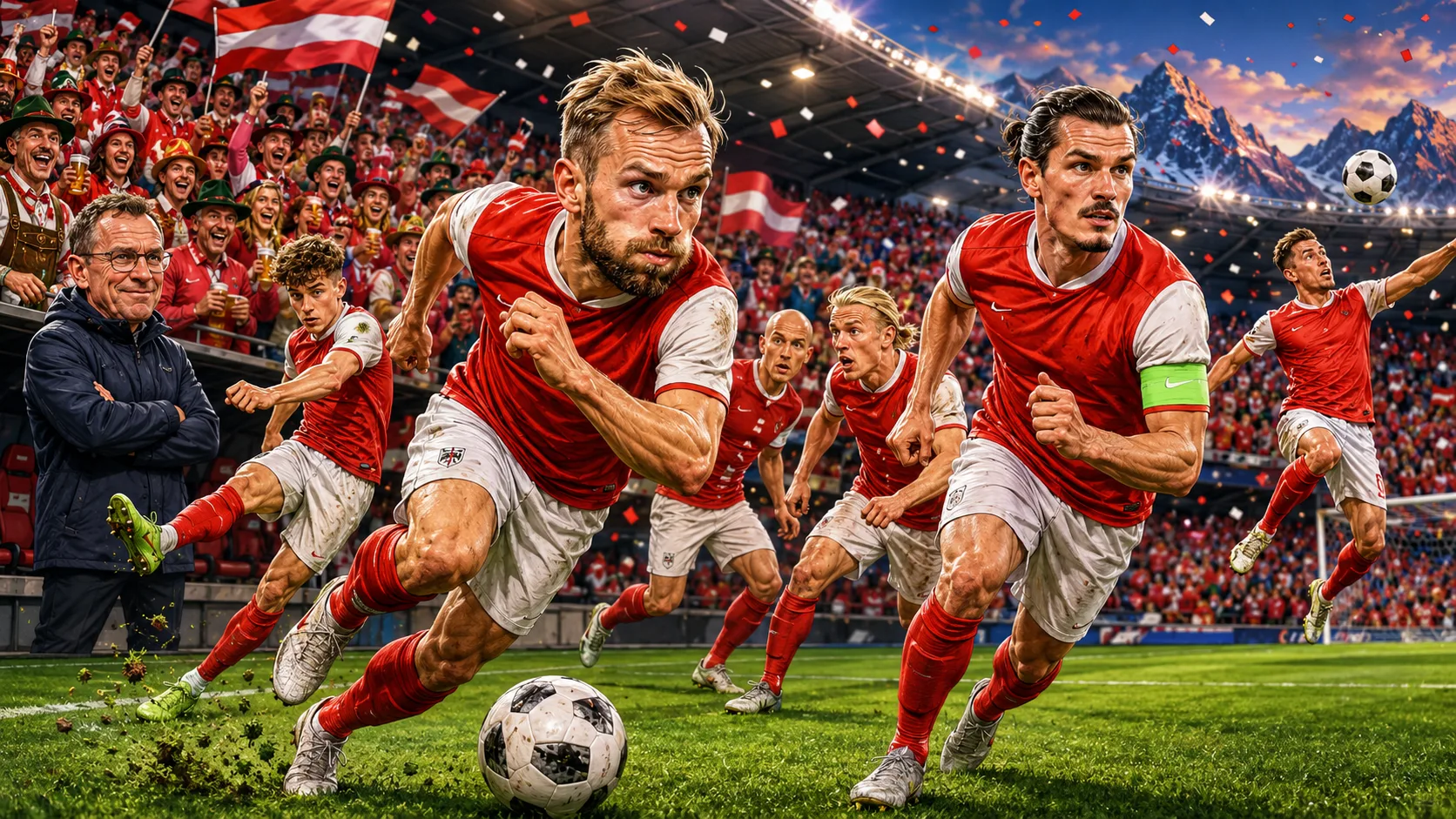
Team Overview
Austria are one of the more tactically mature teams at World Cup 2026. Their identity has been stable for years, and the squad has benefited from continuity. That is a major tournament advantage. International football often punishes sides still searching for chemistry; Austria do not have that problem.
Their football is based on intensity. They want to force opponents into uncomfortable decisions, reduce the time available on the ball and make matches feel faster than opponents want them to be. The pressing is not chaotic. It is ball-oriented, coordinated and designed to close passing lanes while pushing play into areas where Austria can trap and recover possession.
When Austria have the ball, they prefer purpose over patience. Backward and sideways passes are not banned, but they are not the instinct. Rangnick wants forward play, quick progression and immediate pressure after loss. That creates a team that can be exhausting to face, especially in group-stage matches where rhythm and recovery are already affected by travel and conditions.
The injury to Baumgartner is a major setback. He is an important runner, scorer and link player, and his absence removes one of Austria’s best attacking connectors. Rangnick has decided not to let that change the national idea. Austria will not rebuild themselves around one absence. They will adjust personnel, but the principles remain.
This team’s strength is collective function. Austria are not Argentina, where one genius can change the geometry of a match. They are not Algeria, where individual technical expression can suddenly open a game. They are a machine built on habits, distances and work-rate. If that machine runs well, Austria can qualify comfortably. If it loses balance, the same aggression that makes them dangerous can expose them.
World Cup History
Austria have a deeper World Cup history than many casual observers remember. Their greatest finish came in 1954, when they placed third after a dramatic tournament in Switzerland. That side remains the historical benchmark for Austrian football at the finals.
They also made significant appearances in earlier decades, including strong campaigns before and after the Second World War. Austria’s footballing identity has often been connected to technical culture and central European tactical intelligence, but their modern national-team story has been more complicated.
The 1978 World Cup produced one of Austria’s most famous victories: a 3-2 win over West Germany in Córdoba. That result remains celebrated as one of the great moments in Austrian football history. Four years later, Austria were involved in one of the tournament’s most controversial episodes, the 1982 match against West Germany in Gijón that eliminated Algeria. The historical echo of that moment will return in Group J when Austria face Algeria again.
Austria’s last World Cup appearance before 2026 came in France 1998. They failed to get out of the group, and the national team then spent nearly three decades away from the global stage. That absence makes this tournament meaningful. A generation of Austrian supporters has waited to see their side back at the finals.
The difference now is expectation. Austria are not returning as a nostalgic participant. Rangnick’s work has made them a team with a clear tactical identity and realistic knockout ambitions. The minimum target is no longer simply to enjoy the experience; it is to compete properly and reach the Round of 32.
Road to World Cup 2026
Austria qualified as UEFA Group H winners, confirming the progress made under Rangnick. The campaign was not without stress, but it ultimately reflected the side’s maturity. They handled pressure, stayed loyal to their approach and arrived in North America with belief that qualification was deserved rather than fortunate.
The defeat away to Romania briefly raised questions. Mircea Lucescu suggested that Austria’s stability could become a weakness because opponents knew exactly how they played. The comment touched on a real tactical issue. Austria are no secret. Their system has been visible for years, and rivals can prepare for the pressing patterns.
Rangnick’s response was not to abandon the idea. He doubled down on the value of clarity. Austria know who they are. At international level, that matters enormously. Many teams spend tournaments trying to find themselves under pressure. Austria should not have to.
The qualification campaign also reinforced the importance of the midfield. Laimer, Seiwald and Schlager give the team energy, structure and pressing intelligence. Sabitzer offers attacking timing and leadership. The back line, led by Lienhart and supported by Posch, gives enough solidity to allow the front six to hunt aggressively.
The pre-tournament injury to Baumgartner changed the emotional tone, but not the target. Austria still have a settled squad and a coach whose principles are fully embedded. The challenge is to carry qualifying authority into a World Cup group where opponents are more varied and mistakes are punished harder.
The Coach
Ralf Rangnick is the defining figure of modern Austria. It is never simple for a German coach to win Austrian affection, but Rangnick has done it through results, honesty and a tactical identity that supporters can recognise. He has restored competitive pride after years of uneven expectation.
His wider reputation is well established. Rangnick helped shape modern German-speaking football through his pressing ideas, especially during his work with RB Leipzig and within the Red Bull football structure. His brief spell at Manchester United did not bring the same influence, but it did not erase the authority he had built over decades.
With Austria, the fit has been strong because Rangnick has players capable of absorbing complex collective demands. He speaks directly, praises when he thinks it is deserved and criticises when standards drop. That directness can create friction, but it also creates clarity. Players know what is expected.
His football is based on pressure and forward thinking. Austria create overloads around the ball, sprint at opponents, block passing lanes and force rushed decisions. In possession, they want to play forward quickly rather than circulate passively. It is a demanding style physically and mentally.
At World Cup 2026, Rangnick’s task is to manage energy as much as tactics. Pressing is powerful, but a long tournament requires smart use of intensity. Austria cannot sprint wildly for three group games without control. The best version of Rangnick’s side will know when to attack the ball and when to protect the shape.
Star Player
Konrad Laimer is Austria’s star player, not because he is the flashiest name but because he may be the most complete and useful footballer in the squad. His importance to Bayern Munich underlines his level, and his role for Austria is central to the way Rangnick wants to play.
Laimer is the kind of player coaches trust instinctively. He covers ground relentlessly, presses with intelligence, tackles aggressively and passes with enough quality to keep the team moving. His versatility makes him even more valuable. He can play at right-back, left-back or in central midfield, and he understands the requirements of each role.
In Austria’s system, that versatility is not a luxury. It is tactical currency. Laimer can help overload one side, cover transitions, step into midfield or protect wide spaces depending on match state. Against Jordan, he may be used to help sustain pressure. Against Argentina, he may need to help contain Messi and the midfield rotations. Against Algeria, his duel with technical midfielders could be decisive.
Laimer’s game is also symbolic of Austria’s identity. He does not wait for football to come to him. He goes looking for it. He plays with urgency, force and tactical discipline. Those qualities are exactly why Rangnick’s Austria can be greater than the sum of their parts.
If Austria go deep, Sabitzer may produce the headline moments and Wanner may attract attention, but Laimer’s influence will likely be the foundation.
One to Watch
Paul Wanner is Austria’s one to watch. His decision to represent Austria rather than Germany was a major boost, and his profile gives Rangnick a fascinating young talent to develop within a demanding collective system.
Wanner has the left foot, vision and technical smoothness associated with elite attacking midfielders, but his development has not been limited to a luxury role. At PSV Eindhoven, he was reshaped into a deeper position, learning the responsibilities of a No 6 and adding tactical maturity to his natural creativity.
That evolution makes him especially interesting for Austria. Rangnick’s team require players who can think quickly under pressure. Wanner can pass with precision, carry the ball at speed and break lines from deeper zones. He gives Austria a different kind of midfield tool: less about pure pressing volume, more about technical progression.
At 20, he will not be asked to carry the team. But tournaments often create space for a young player to accelerate his reputation. If Austria need more creativity after Baumgartner’s injury, Wanner could become increasingly important.
His challenge is physical and tactical consistency. The World Cup is unforgiving. Opponents will press him, target him and test his defensive discipline. If he handles that, Austria may have one of the tournament’s breakout midfielders.
Unsung Hero
Nicolas Seiwald is Austria’s unsung hero. He rarely attracts the glamour attached to attacking players or the admiration given to versatile stars such as Laimer, but he is essential to the structure.
Seiwald does the quiet work that allows Austria’s pressing to stay connected. He closes spaces, tracks second balls, supports overloads and makes sure the midfield does not become stretched. In a system as aggressive as Austria’s, that responsibility is enormous.
His reliability is shown by how rarely Rangnick leaves him out. Coaches do not repeatedly select players like Seiwald because of highlight reels. They select them because they trust their positioning, concentration and decision-making.
On the ball, Seiwald is neat rather than spectacular. That suits Austria. They do not need every midfielder to take risks. They need someone who can protect rhythm, keep circulation clean and react quickly when possession changes hands.
Against Argentina, Seiwald may spend long spells managing spaces around Messi and Argentina’s midfielders. Against Algeria, he will need to prevent central overloads. Against Jordan, he can help Austria sustain pressure and recycle attacks. If he performs well, Austria’s entire system looks more stable.
Tactical Style and What to Expect
Austria’s tactical style is built around pressing, counterpressing and vertical play. Rangnick wants his side to defend forward. The first objective is to make the opponent uncomfortable in possession, not simply wait in a low block. When Austria press correctly, they can turn the opponent’s build-up into their own attacking platform.
The likely shape is a 4-2-3-1 or 4-2-2-2 depending on personnel. Sabitzer can operate as the advanced midfielder or inside forward. Laimer may be used in midfield or at full-back. Seiwald and Schlager provide the central engine, while Posch and Lienhart give defensive structure.
Baumgartner’s absence removes an important attacking connector, so Austria may need to distribute his responsibilities. Wanner can offer creativity, Romano Schmid can help between lines and Michael Gregoritsch or Marko Arnautovic can provide penalty-box presence depending on selection.
The pressing approach creates clear strengths. Austria can force turnovers in dangerous areas, disrupt possession teams and make opponents play faster than they want. It also creates risk. If the first line is bypassed, space can appear behind midfield. Against Argentina, that is dangerous. Against Algeria, it can invite technical runners into open grass. Against Jordan, it can leave counter-attacking lanes.
The reason Austria are dangerous is that they usually manage those risks well. Their distances are strong, their midfielders understand cover roles and their defenders are used to stepping out. The style is not new, but it is deeply rehearsed.
Strengths
- Clear tactical identity: Austria know exactly how they want to play under Rangnick, with pressing and vertical attacks at the centre of the plan.
- Midfield continuity: Laimer, Seiwald and Schlager give the team energy, familiarity and collective intelligence.
- Pressing discipline: Austria rarely lose their balance when applying pressure, which makes them more secure than many high-pressing teams.
- Squad togetherness: The group has played together for years and carries a strong sense of trust and hierarchy.
Weaknesses
- Predictability: Opponents know Austria’s patterns and can prepare specifically for their pressing traps.
- Baumgartner injury: Losing an important attacking midfielder reduces their goal threat and between-the-lines movement.
- Limited star power: Austria rely more on collective function than individual match-winners.
- Space behind pressure: If the press is beaten, elite opponents can attack gaps quickly.
Probable Starting XI
Formation: 4-2-3-1
Patrick Pentz; Stefan Posch, Philipp Lienhart, Kevin Danso, Phillipp Mwene; Nicolas Seiwald, Xaver Schlager; Konrad Laimer, Marcel Sabitzer, Romano Schmid; Michael Gregoritsch.
Rangnick has several alternatives. Marko Arnautovic can start if Austria want more experience and penalty-box presence, Paul Wanner can be used if more creativity is required, and Laimer’s versatility means the midfield and full-back roles can be adjusted depending on opponent.
Group Stage Fixtures
- Wednesday, 17 June 2026: Austria vs Jordan — San Francisco Bay Area Stadium, Santa Clara — 08:00 MUT
- Monday, 22 June 2026: Argentina vs Austria — Dallas Stadium, Arlington — 21:00 MUT
- Sunday, 28 June 2026: Algeria vs Austria — Kansas City Stadium, Kansas City — 06:00 MUT
Key Match
The key match is Algeria vs Austria. Argentina are favourites to win the group, and Austria will expect to beat Jordan if they perform properly. That leaves the final group match against Algeria as the likely battle for second place.
The tactical contrast is ideal for a decisive World Cup fixture. Algeria want to build technically, use Mahrez and Maza between lines and progress through midfield. Austria want to press, trap and force mistakes. If Austria’s pressure lands, they can turn Algeria’s build-up into chances. If Algeria play through it, Austria may be exposed.
The historical angle adds spice. Algeria’s supporters still remember 1982, and Austria’s involvement in that tournament’s controversy gives the fixture emotional weight. The current players are not responsible for that history, but World Cups are built on memory as well as tactics.
For Rangnick, the match may come down to discipline. Austria must press with intensity but not recklessness. They must attack forward without leaving huge gaps. If they manage the balance, they can take the result they need.
Can They Qualify From The Group?
Yes, Austria can qualify from Group J. They are strong candidates to finish second behind Argentina, although Algeria will push them hard and Jordan cannot be treated casually. The expanded format also gives Austria a possible safety net through the third-place route, but Rangnick’s team should aim higher.
The opener against Jordan is essential. Dropping points there would immediately complicate the group. Jordan will defend, counter and play with pride, so Austria must be patient without losing their attacking aggression.
The Argentina match is a free hit in some ways but not a throwaway fixture. A point would be enormous. Even a narrow defeat with a strong performance could protect morale and goal difference before the Algeria match.
Four points may be enough to progress. Six would almost certainly do it. Austria’s path is clear: beat Jordan, compete with Argentina, then avoid defeat or beat Algeria depending on the group table.
Prediction
Goal.mu prediction: Austria to finish second in Group J and reach the Round of 32, with the Algeria match deciding whether Rangnick’s pressing machine controls its own route or relies on third-place calculations.
Argentina should top the group. Austria have the structure, experience and pressing quality to edge Algeria for second, even without Baumgartner. The key is avoiding a slow start against Jordan and managing physical energy across three very different matches.
If Laimer, Sabitzer, Seiwald and Schlager stay fit, Austria have the midfield intelligence to compete. If the press loses accuracy or the attack misses Baumgartner too heavily, their route becomes less comfortable.
Hot Stat
Austria’s best World Cup finish remains third place in 1954, while their 2026 return ends a 28-year absence from the tournament.
Final Analysis
Austria may not be the most glamorous team at World Cup 2026, but they are one of the clearest. They know their plan, their coach, their roles and their collective strengths. In tournament football, that matters.
Rangnick has built a side that plays with identity. Austria press with conviction, attack quickly and trust their shared habits. The loss of Baumgartner hurts, but it does not remove the system. This team is not dependent on one player to know what it is.
The challenge is execution. Jordan must be treated seriously, Argentina must be managed intelligently and Algeria must be confronted with the right mix of aggression and patience. Austria’s group campaign will not be decided by theory. It will be decided by whether their pressing remains precise under World Cup pressure.
Laimer gives them versatility and force. Sabitzer gives them attacking authority. Seiwald gives them structure. Schlager gives them intensity. Rangnick gives them belief in a plan that has been rehearsed for years.
If Austria keep their balance, they can reach the knockout stage and make life uncomfortable for stronger names. They may not surprise opponents with what they do, but they can still beat them by doing it better than expected.
World Cup 2026 Team Guide
🇦🇹 Austria World Cup 2026 Fixtures, Squad & Predictions
Austria arrive with a modern pressing identity and one of their strongest tournament teams in years. Group J gives them a chance to show that European progress can translate to the World Cup.
| Team | P | W | D | L | GF | GA | GD | Pts |
|---|---|---|---|---|---|---|---|---|
| 🇦🇷 Argentina | 3 | 3 | 0 | 0 | 8 | 0 | 8 | 9 |
| 🇦🇹 Austria | 3 | 1 | 1 | 1 | 6 | 6 | 0 | 4 |
| 🇩🇿 Algeria | 3 | 1 | 1 | 1 | 5 | 7 | -2 | 4 |
| 🇯🇴 Jordan | 3 | 0 | 0 | 3 | 2 | 8 | -6 | 0 |
World Cup 2026
Fixtures in Mauritius Time
All times below are shown in Mauritius Time (MUT).
Wednesday 17 June 2026
🇦🇹 Austria 3 - 1🇯🇴 Jordan
Group J • Santa Clara, USA
Santa Clara StadiumMonday 22 June 2026
🇦🇷 Argentina 2 - 0🇦🇹 Austria
Group J • Arlington, USA
Arlington StadiumSunday 28 June 2026
🇩🇿 Algeria 3 - 3🇦🇹 Austria
Group J • Kansas City, USA
Kansas City StadiumThursday 2 July 2026
🇪🇸 Spain 3 - 0🇦🇹 Austria
Round of 32 • Los Angeles, USA
SoFi StadiumGoal.mu Predictions
World Cup 2026 Predictions
🇲🇽 Mexico vs 🇿🇦 South Africa
🇰🇷 South Korea vs 🇨🇿 Czech Republic
🇨🇦 Canada vs 🇧🇦 Bosnia & Herzegovina
🇺🇸 USA vs 🇵🇾 Paraguay
🇶🇦 Qatar vs 🇨🇭 Switzerland
🇧🇷 Brazil vs 🇲🇦 Morocco
🇭🇹 Haiti vs 🏴 Scotland
🇦🇺 Australia vs 🇹🇷 Turkey
The content provided in this article is intended solely for informational and entertainment purposes. Betting and gambling involve significant risks, including the potential loss of the principal amount wagered. Readers should be aware of their local regulations and laws concerning online betting and gambling. Always gamble responsibly, knowing that the outcomes are unpredictable and can lead to financial losses.If you or someone you know may have a gambling problem, please seek help. Many organizations provide resources and support for individuals struggling with gambling addiction. Remember, the best bet is always a well-informed decision.Never gamble with funds that are essential for your daily life, and always set limits to ensure you’re not gambling more than you can afford to lose. The thrill of the bet should never overshadow the potential consequences of loss. Stay safe, informed, and gamble responsibly.