Argentina World Cup 2026 Guide, Fixtures, Results & History
Argentina at World Cup 2026: Team Preview, History, Key Players & Prediction
Argentina World Cup 2026 preview: Lionel Scaloni’s reigning champions return to defend their crown with Lionel Messi heading into a record sixth World Cup, a familiar title-winning core still intact and a new generation trying to carry the Albiceleste beyond the emotional high of Qatar.
Argentina arrive in North America with a rare burden: defending the World Cup. The last four years have transformed the national team from a side haunted by near misses into one of international football’s most complete winning machines. The 2021 Copa América ended a long trophy drought, Qatar 2022 delivered the third star, and another continental triumph confirmed that Scaloni’s era was not simply one golden winter built around Messi’s final peak.
The question now is whether Argentina can do it again. Retaining the World Cup is one of the hardest tasks in football. The champions are studied, targeted and emotionally drained by the weight of their own achievement. Many of the same players remain from Qatar, but this is not exactly the same squad. Ángel Di María has gone, some senior players are carrying the physical consequences of a demanding club season, and the younger generation must now offer more than promise.
Group J looks manageable on paper, but it still contains real danger. Algeria are technically gifted and awkward to judge. Austria bring structure, pressing and a fierce collective identity under Ralf Rangnick. Jordan are debutants but have enough emotional energy to make the final match uncomfortable if Argentina lose focus. Scaloni’s team should top the group, but the margins of modern World Cup football rarely allow complacency.
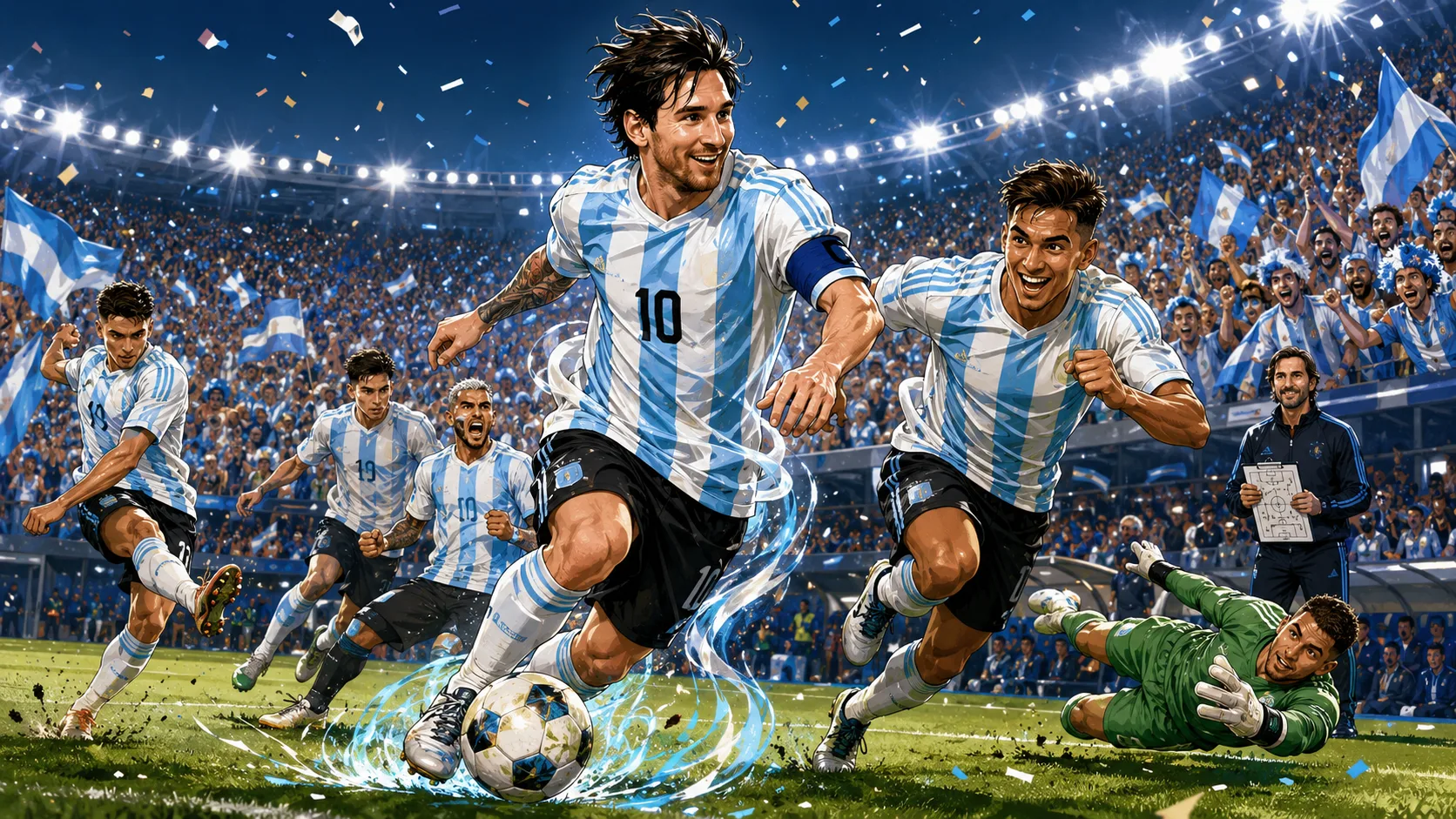
Team Overview
Argentina enter World Cup 2026 as reigning champions and one of the tournament favourites. Their biggest strength is not only talent, although the talent remains obvious. Their biggest strength is chemistry. This squad has lived through qualification pressure, continental success, a World Cup final, penalty drama and the emotional weight of Messi’s greatest triumph. They know what winning looks like because they have already done it together.
Scaloni’s expected plan is to keep the 4-3-3 shape that gives Argentina balance between defensive security, midfield control and attacking flexibility. The back line should retain the aggressive but organised character of recent years, with centre-backs who defend front-foot duels and full-backs who provide attacking width. The midfield remains the heartbeat, combining running, passing and tactical intelligence.
The forward line has changed in tone. Messi still leads the team, but Argentina are no longer psychologically helpless without him. Julián Alvarez brings work-rate, pressing and penalty-box threat. Lautaro Martínez gives Scaloni a different striker profile and is determined to arrive in better condition than he did in Qatar. Thiago Almada may be asked to fill some of the creative void left by Di María, while Nico Paz offers a younger, elegant option between the lines.
This squad is not at a physical peak across the board. A demanding European and domestic season has left several players managing injury concerns or heavy minutes. That makes rotation and squad management more important than ever. Argentina’s depth will be tested not only by opponents but by travel, heat, recovery windows and the emotional energy required to chase back-to-back titles.
Even so, Argentina’s floor is high. Their identity is strong, their coach is trusted and their senior players understand tournament rhythm. The challenge is not to rediscover belief. It is to avoid the comfort of past success and play with the hunger of a team still chasing something.
World Cup History
Argentina’s World Cup history is among the richest in the game. The Albiceleste won their first title on home soil in 1978, a tournament defined by Mario Kempes, fierce national pressure and the emergence of Argentina as world champions. Eight years later, Diego Maradona produced one of the greatest individual tournaments ever seen, guiding Argentina to the 1986 title in Mexico.
For decades, those two stars framed the national team’s identity. Argentina came close again in 1990, losing the final to West Germany, and suffered further heartbreak across the following generations. The 2014 final defeat to Germany became another wound, particularly for Messi, whose international career had long been judged through the impossible lens of whether he could deliver a World Cup.
Qatar 2022 changed everything. Argentina recovered from a shock opening defeat to Saudi Arabia, grew through the tournament and beat France in one of the greatest finals in World Cup history. Messi scored twice in the final and Argentina won on penalties after a 3-3 draw, with Emiliano Martínez again central to the story. The third star was secured, and Messi’s international legacy was completed.
That triumph also elevated Scaloni into a new category. He had taken charge without the reputation of Argentina’s historic coaching giants, but he built a team that blended emotional unity with tactical flexibility. The Copa América wins either side of the World Cup confirmed that his success was not accidental.
World Cup 2026 gives Argentina the chance to join an even rarer club. Back-to-back titles have become almost impossible in the modern era. The demands are enormous, but the motivation is clear: defend the crown, honour Messi’s final World Cup years and prove that this generation is not finished.
Road to World Cup 2026
Argentina’s qualification campaign was controlled and convincing. They finished top of the CONMEBOL section, well clear of the chasing pack, and managed the campaign with the authority expected of world champions. It was not a procession in every match, but it rarely felt as if their place in North America was in serious doubt.
One of the defining moments was a historic qualifying win away to Brazil. Argentina have long understood the emotional value of beating their great rivals, but winning a World Cup qualifier in Brazil carried particular weight. It reinforced the sense that Scaloni’s group had retained its edge after Qatar.
Messi remained important, but the campaign also showed that Argentina can function when he is managed carefully. That is essential now. At 39 during the tournament, Messi cannot be expected to carry every physical burden. The team must still be built around his genius, but not dependent on him for every solution.
Scaloni used qualification to maintain the core while opening space for younger players. Nico Paz is one of the most interesting additions, offering creativity and technical elegance. Thiago Almada’s role also increased, with the winger-attacking midfielder now positioned to take on greater responsibility after Di María’s departure from the national team.
The champions therefore arrive with both continuity and transition. Almost two thirds of the 2022 squad remain part of the story, but the support cast around Messi has shifted. Argentina are not rebuilding from scratch. They are refreshing a winning structure before time forces bigger changes.
The Coach
Lionel Scaloni is already the most successful coach in Argentina’s history by honours, even if his journey began with scepticism. He did not arrive with the aura of César Luis Menotti, Carlos Bilardo or other legendary figures. He came through as Jorge Sampaoli’s former assistant, first trusted with friendly matches before being confirmed as head coach.
What followed has become one of modern international football’s most remarkable coaching stories. Scaloni built a squad around trust, humility and shared responsibility. He earned Messi’s confidence, created a dressing room that played for each other and found tactical solutions without becoming obsessed with one rigid idea.
His Argentina can press, defend deep, control possession, attack quickly and adjust shape depending on the opponent. That flexibility was crucial in Qatar. Scaloni was not afraid to make brave selection calls, alter midfield balance or use different attacking structures. His calmness became part of the team’s strength.
The 2026 challenge is different. Winning once is hard; keeping the same hunger is harder. Scaloni must manage players who have already reached the summit while integrating younger talents who want to create their own story. He must also handle Messi’s minutes, fitness and emotional influence carefully.
Scaloni has spoken with realism about the difficulty of what awaits. He knows that wearing Argentina’s shirt creates a demand for both results and good football. Supporters expect personality, control and competitive fire. The best team does not always win, but Argentina under Scaloni have often found ways to be the best team when it matters most.
Star Player
Lionel Messi remains Argentina’s star player. No matter how much the team has evolved, no matter how many younger players are ready to take on responsibility, Messi is still the reference point. He is the captain, the symbol and the player every opponent must account for.
This will be Messi’s sixth World Cup, an extraordinary achievement that underlines the scale of his longevity. He will turn 39 during the tournament, and while his physical profile is different from earlier editions, his football intelligence remains unmatched. He sees passing lanes early, controls tempo, manipulates defenders and can still decide matches from moments that seem harmless.
The difference from previous eras is that Argentina no longer appear emotionally paralysed around him. In earlier tournaments, the national team sometimes looked like a group waiting for Messi to solve everything. Scaloni changed that. Rodrigo De Paul, Alexis Mac Allister, Enzo Fernández, Cristian Romero, Emiliano Martínez and others now carry responsibility with pride.
That makes Messi even more dangerous. He does not need to force every action. He can choose moments, conserve energy and use his influence when the match demands it. Alvarez, Lautaro, Almada and Paz can provide movement around him. The midfield can protect him. The defence can keep the team stable.
If Argentina retain the World Cup, Messi’s role may not look the same as it did in Qatar. It may be less physically dominant but no less decisive. The genius is still there. The challenge is to use it at exactly the right moments.
One to Watch
Nico Paz is the one to watch. Born in Tenerife and developed through Real Madrid’s academy, he chose Argentina and has quickly become one of the most elegant young players in the national-team picture. His emergence gives Scaloni a left-footed creative profile who can operate between midfield and attack.
Paz’s appeal lies in his smoothness. He receives well, carries the ball with calm and can connect phases without rushing. At Como, he has built confidence and shown why Argentina were determined to keep him inside their pathway. He is not simply a future name; he is a player who can contribute now.
For Argentina, Paz can offer something valuable in tournament matches where opponents sit deep. Messi cannot be asked to create every central overload. Almada may be used wide or inside. Mac Allister and Enzo can progress from midfield, but Paz gives Scaloni another player who can receive between lines and make decisions quickly.
His tournament role may depend on match state. He could start in certain games, especially if rotation is needed, or become an impact substitute when Argentina need imagination against a compact defence. In a long tournament, those minutes matter.
Argentina’s future beyond Messi will be built around players with courage on the ball. Paz looks like one of them.
Unsung Hero
Thiago Almada is Argentina’s unsung hero for this tournament. He is already a World Cup winner, but his involvement in Qatar was brief. World Cup 2026 could be the moment he becomes a central figure rather than a squad footnote.
Almada’s importance has increased because Di María is no longer part of the national team. Replacing Di María is not only about finding another winger. It is about replacing vertical threat, big-game courage, left-sided or right-sided creativity and the ability to produce moments in finals. Almada cannot simply copy him, but he can provide a fresh version of that role.
He is skilful in one-v-one situations, comfortable drifting inside and capable of striking the ball powerfully from distance. Those qualities give Argentina a useful attacking profile around Messi and Alvarez. He can stretch opponents, combine in tight spaces and create uncertainty.
His recent club form has not always been flawless, but international tournaments often reset players. Almada has the temperament to embrace the stage, and Scaloni appears ready to trust him with more responsibility.
If Argentina go deep, there will likely be at least one match where Almada’s movement or shot-making changes the mood. He may not receive the headline billing, but he could become one of the decisive players in the title defence.
Tactical Style and What to Expect
Argentina’s tactical base remains a 4-3-3, but Scaloni’s team are too flexible to be reduced to one shape. They can become a 4-4-2 without the ball, a 4-2-3-1 when Messi drops into central spaces or a more narrow possession structure when the full-backs push high.
The defence should remain aggressive and experienced. Cristian Romero brings intensity and front-foot defending, while Nicolás Otamendi or Lisandro Martínez can offer leadership and distribution depending on selection. The full-backs are important because Argentina need width when Messi drifts inside.
Midfield is the engine. De Paul gives energy, emotional tone and pressing work. Mac Allister offers intelligence and balance. Enzo Fernández provides passing range and progression. Leandro Paredes can be used for control, while younger options give Scaloni more ways to rotate.
In attack, Messi’s positioning defines the rhythm. He can start wide, drift centrally or play behind Alvarez. Julián Alvarez gives pressing, movement and selfless running. Lautaro Martínez offers penalty-box finishing and a more traditional striker profile. Almada and Paz can provide creativity, while other wide options can stretch opponents.
The key difference from Qatar may be how Argentina replace Di María’s directness. Almada is the obvious candidate, but Scaloni may use different solutions depending on the opponent. Against Algeria, Argentina may need patience and counter-pressing. Against Austria, press resistance will be vital. Against Jordan, chance creation against a defensive block will be the main task.
Strengths
- Champion mentality: Argentina know how to handle tournament pressure because this core has already won everything together.
- Messi’s influence: Even at 39, Messi’s vision, leadership and timing remain unique weapons.
- Midfield balance: De Paul, Mac Allister and Enzo give Argentina energy, passing quality and tactical intelligence.
- Squad continuity: Much of the Qatar-winning group remains, giving Scaloni chemistry few national teams can match.
Weaknesses
- Physical condition: Several players arrive after heavy club seasons and injury setbacks, making rotation important.
- Replacing Di María: Argentina must find a new source of direct wide magic in major matches.
- Defending a title: Every opponent will treat the champions as a target.
- Age management: Messi and other senior figures must be protected across a long, demanding tournament.
Probable Starting XI
Formation: 4-3-3
Emiliano Martínez; Nahuel Molina, Cristian Romero, Nicolás Otamendi, Nicolás Tagliafico; Rodrigo De Paul, Enzo Fernández, Alexis Mac Allister; Lionel Messi, Julián Alvarez, Thiago Almada.
Scaloni has several strong alternatives. Lautaro Martínez can start as the central striker, Lisandro Martínez can change the defensive profile, Marcos Acuña adds left-sided experience, Leandro Paredes gives extra control, and Nico Paz offers a high-upside creative option if Argentina need more invention.
Group Stage Fixtures
- Wednesday, 17 June 2026: Argentina vs Algeria — Kansas City Stadium, Kansas City — 05:00 MUT
- Monday, 22 June 2026: Argentina vs Austria — Dallas Stadium, Arlington — 21:00 MUT
- Sunday, 28 June 2026: Jordan vs Argentina — Dallas Stadium, Arlington — 06:00 MUT
Key Match
The key match is Argentina vs Austria. The Algeria opener is important because it starts the title defence, but Austria are likely to be the most organised and physically intense opponent in the group. Rangnick’s team can press, run and disrupt rhythm, which makes them a serious test for Argentina’s midfield.
If Argentina beat Algeria first, the Austria match becomes a chance to confirm control of the group. If they stumble in the opener, it becomes a pressure game. Austria’s pressing could expose any lack of sharpness among players returning from heavy club seasons.
For Scaloni, the match will demand technical bravery. Argentina must play through pressure rather than simply go long too early. Messi, Mac Allister, Enzo and De Paul will need to find the correct tempo. If they do, Austria can be opened up. If not, the group becomes more awkward.
Can They Qualify From The Group?
Argentina should qualify from Group J and are clear favourites to finish first. They have the best squad, the most tournament experience and the strongest individual match-winners in the section. Anything other than progression would be a major shock.
The real question is how comfortably they qualify. Algeria have enough technical quality to create problems if Argentina are slow in transition. Austria can press and make the second match extremely demanding. Jordan will play with freedom and emotion, particularly if the final match still carries qualification stakes.
Argentina’s ideal route is to win the first two matches and rotate where possible against Jordan. That would protect senior players and help younger options gain tournament rhythm. If they need a result in the final game, the group will have become more complicated than expected.
In the expanded format, even a slow start is survivable, but champions cannot think that way. Argentina will want first place, a clean qualification path and momentum for the Round of 32.
Prediction
Goal.mu prediction: Argentina to finish first in Group J and reach at least the quarter-finals, with a realistic chance of another semi-final or final if Messi remains fit and the younger supporting cast contributes.
The champions have enough quality to win the group. Their experience gives them a clear edge over Algeria, Austria and Jordan. The bigger challenge comes later, when physical demands rise and the emotional intensity of defending the crown becomes heavier.
Argentina can retain the World Cup, but the task is enormous. To do it, they need Messi managed carefully, Alvarez or Lautaro finishing efficiently, Almada stepping into a bigger role and the midfield remaining as sharp as it was during the best phases of the Scaloni era.
Hot Stat
Messi is set for a record sixth World Cup appearance, extending a tournament journey that began in 2006 and reached its defining peak with Argentina’s 2022 triumph in Qatar.
Final Analysis
Argentina arrive at World Cup 2026 with history behind them and pressure in front of them. The third star changed the emotional story of the national team, but it also raised the standard. This squad is no longer chasing redemption. It is defending a throne.
Scaloni’s greatest achievement has been creating a team around Messi that does not collapse without him. That remains essential. Messi is still the symbol, still the genius and still the player opponents fear most, but Argentina’s title defence will require collective depth.
Almada, Paz and Alvarez represent the next layer. De Paul, Mac Allister and Enzo remain the competitive engine. Emiliano Martínez brings the goalkeeper personality every tournament contender needs. Romero gives the defence edge. Around them, Scaloni must manage legs, egos and expectations.
Group J should be manageable, but not meaningless. Algeria, Austria and Jordan will each test Argentina in different ways. The champions must use the group stage to sharpen rather than coast.
If Messi is fit, if the midfield stays intense and if the new creative pieces step forward, Argentina will be one of the most dangerous teams in North America. Back-to-back World Cups remain a huge ask, but this group has already shown that impossible expectations do not frighten them.
The content provided in this article is intended solely for informational and entertainment purposes. Betting and gambling involve significant risks, including the potential loss of the principal amount wagered. Readers should be aware of their local regulations and laws concerning online betting and gambling. Always gamble responsibly, knowing that the outcomes are unpredictable and can lead to financial losses.If you or someone you know may have a gambling problem, please seek help. Many organizations provide resources and support for individuals struggling with gambling addiction. Remember, the best bet is always a well-informed decision.Never gamble with funds that are essential for your daily life, and always set limits to ensure you’re not gambling more than you can afford to lose. The thrill of the bet should never overshadow the potential consequences of loss. Stay safe, informed, and gamble responsibly.
World Cup 2026 Team Guide
🇦🇷 Argentina World Cup 2026 Fixtures, Squad & Predictions
Argentina enter World Cup 2026 as defending champions and one of the tournament’s biggest stories. Their challenge is to protect a winning identity while managing squad evolution.
| Team | P | W | D | L | GF | GA | GD | Pts |
|---|---|---|---|---|---|---|---|---|
| 🇦🇷 Argentina | 3 | 3 | 0 | 0 | 8 | 0 | 8 | 9 |
| 🇦🇹 Austria | 3 | 1 | 1 | 1 | 6 | 6 | 0 | 4 |
| 🇩🇿 Algeria | 3 | 1 | 1 | 1 | 5 | 7 | -2 | 4 |
| 🇯🇴 Jordan | 3 | 0 | 0 | 3 | 2 | 8 | -6 | 0 |
World Cup 2026
Fixtures in Mauritius Time
All times below are shown in Mauritius Time (MUT).
Wednesday 17 June 2026
🇦🇷 Argentina 3 - 0🇩🇿 Algeria
Group J • Kansas City, USA
Kansas City StadiumMonday 22 June 2026
🇦🇷 Argentina 2 - 0🇦🇹 Austria
Group J • Arlington, USA
Arlington StadiumSunday 28 June 2026
🇯🇴 Jordan 0 - 3🇦🇷 Argentina
Group J • Arlington, USA
Arlington StadiumSaturday 4 July 2026
🇦🇷 Argentina 1 - 1🇨🇻 Cape Verde
Round of 32 • Miami, USA
Miami StadiumTuesday 7 July 2026
🇦🇷 Argentina 3 - 2🇪🇬 Egypt
Round of 16 • Arlington, USA
Arlington StadiumSunday 12 July 2026
🇦🇷 Argentina 1 - 1🇨🇭 Switzerland
Quarter-final • Kansas City, USA
GEHA Field at Arrowhead StadiumWednesday 15 July 2026
🏴 England 1 - 2🇦🇷 Argentina
Semi-final • Atlanta, USA
Mercedes-Benz StadiumSunday 19 July 2026
🇪🇸 Spain 0 - 0🇦🇷 Argentina
Final • New Jersey, USA
TBCGoal.mu Predictions