Algeria World Cup 2026 Guide, Fixtures, Results & History
Algeria at World Cup 2026: Team Preview, History, Key Players & Prediction
Algeria World Cup 2026 preview: Vladimir Petkovic’s Fennecs arrive in Group J as one of the tournament’s most intriguing unknowns, with Riyad Mahrez still carrying the aura, Ibrahim Maza offering the future and a technical squad trying to prove that attractive football can survive elite pressure.
Algeria enter World Cup 2026 with a profile that is both exciting and difficult to measure. Their recent record looks impressive, their attacking numbers are strong and their qualification campaign was comfortable, but the level of opposition leaves a major question unanswered: how good are the Fennecs when the opponent is not simply organised, but genuinely elite?
That question will be answered quickly in North America. Algeria are in Group J with reigning champions Argentina, Austria and World Cup debutants Jordan. The opening match against Argentina is the most glamorous and most brutal test. Jordan will be a match Algeria are expected to control, while the final group game against Austria may decide whether Petkovic’s side reach the knockout rounds or leave with regret.
There is no shortage of technical quality. Mahrez remains the captain and one of Algeria’s greatest footballers. Rayan Aït-Nouri gives them modern full-back creativity. Ibrahim Maza brings sharp movement between the lines. Hicham Boudaoui offers the running power that keeps the midfield alive. Amine Gouiri, Mohamed Amoura, Anis Hadj Moussa and Baghdad Bounedjah provide different attacking profiles.
But Algeria are still an unproven commodity at this level. Their football can look sophisticated: patient build-up, aggressive pressing, wide rotations and technical progression through midfield. Yet when the pace rises and the margins narrow, they can also look exposed. The World Cup will reveal whether this is a side ready for a serious knockout push or a talented team still searching for tournament maturity.
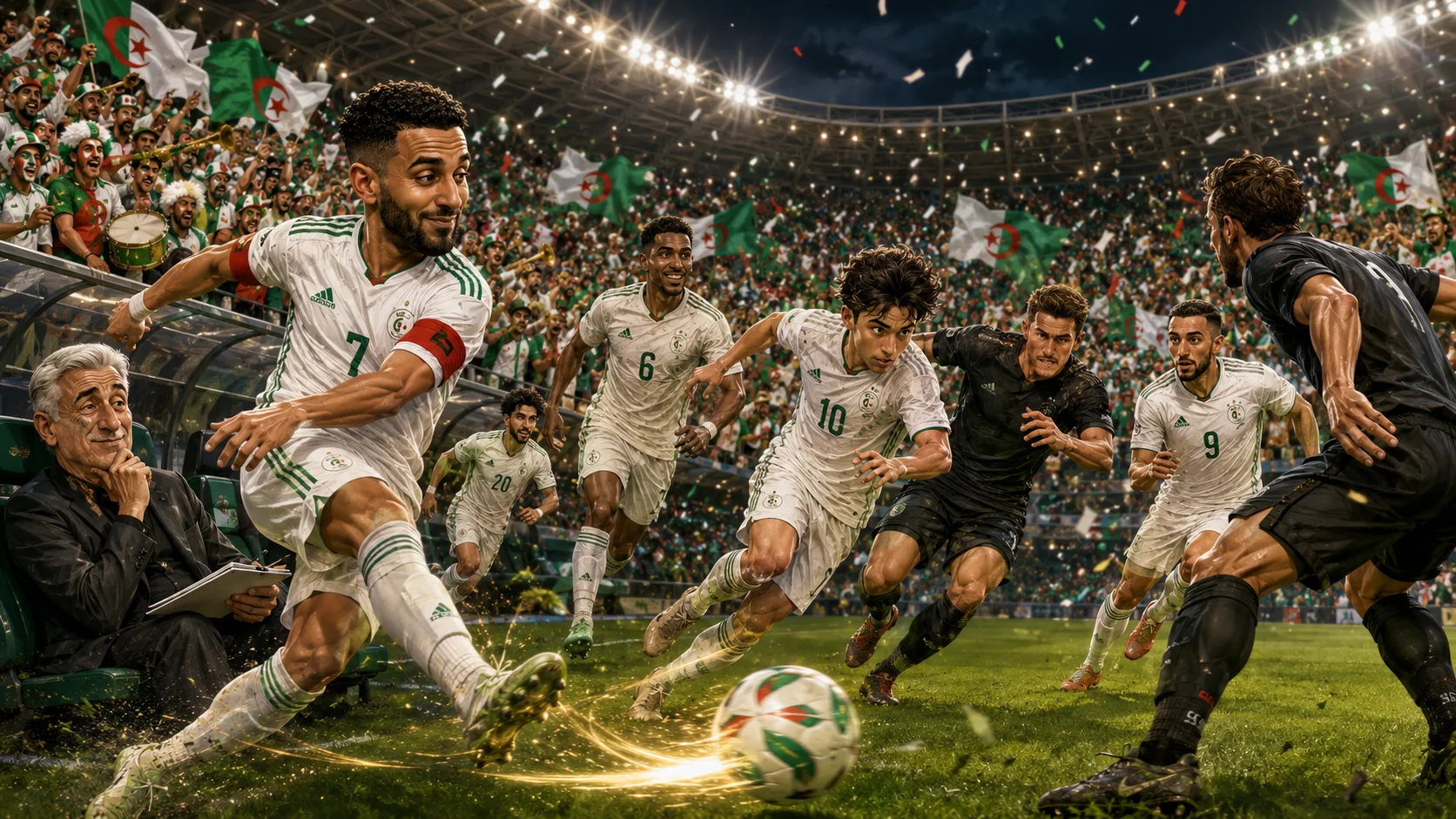
Team Overview
Algeria arrive in North America with the feel of a team that could move in several directions. They have the individual ability to become one of the most watchable African sides at the tournament, but they also carry tactical risk. Petkovic has encouraged a more technical and flexible identity, and that can make Algeria attractive to watch. It can also leave space for opponents to exploit.
The squad is built around technical footballers who are comfortable receiving under pressure. Algeria are capable of building patiently from goal kicks, moving the ball through midfield and creating overloads on the left side, especially when Aït-Nouri is involved. They can press high, dominate possession and use their attacking midfielders to find pockets between the lines.
The issue is not style. It is resistance. Algeria have looked excellent against opponents who cannot punish the gaps they leave. Against stronger teams, particularly those with elite transition players, the defensive line and midfield spacing can be tested. Argentina, Austria and Jordan will all present different tactical problems, from Argentina’s technical control to Austria’s pressing and Jordan’s counter-attacks.
The group dynamic gives Algeria a realistic chance. Argentina are favourites to top the section. Jordan are spirited debutants but remain the team Algeria must beat. Austria are likely the direct rival for second place. That final fixture in Kansas City could become the defining match of Algeria’s campaign.
Petkovic’s task is to blend freedom with discipline. If Algeria open too much, they may be punished. If they become too cautious, they risk wasting the creativity of Mahrez, Maza, Aït-Nouri and Gouiri. The best version of Algeria is brave, technical and organised enough to recover the ball quickly after losing it.
World Cup History
Algeria’s World Cup history carries pride, frustration and unfinished business. Their first appearance came in 1982, and it remains one of the most famous campaigns by an African team. Algeria stunned West Germany 2-1 in their opening match, a result that should have set up a historic progression to the next round.
Instead, the tournament became remembered for the “Disgrace of Gijón”, when West Germany and Austria played out a result that eliminated Algeria. The episode remains one of the most controversial moments in World Cup history and is part of the reason simultaneous final group matches became standard.
Algeria returned in 1986 but could not escape the group. They then spent many years away before coming back in 2010, where they again struggled to turn competitive performances into enough points.
The breakthrough came in 2014. Under Vahid Halilhodžić, Algeria reached the Round of 16 for the first time. Their performance against Germany in Porto Alegre became a landmark display: brave, intense, technically assured and fearless. Germany eventually won after extra time, but Algeria left the tournament with enormous respect.
That 2014 run remains the benchmark. The current squad has a different profile, but the target is similar: reach the knockout stage and prove that Algeria belong among the serious African challengers. Group J is not easy, yet it offers a realistic route if they handle Jordan and get the Austria match right.
Road to World Cup 2026
Algeria qualified with authority. Their campaign was comfortable, with Guinea and Mozambique providing the strongest tests in a group that Algeria were expected to control. The Fennecs scored freely, dominated long spells and rarely looked in serious danger of missing out.
That comfort creates two interpretations. The positive view is that Algeria were efficient, focused and professional. They handled the task placed in front of them and used qualification to build confidence under Petkovic. The cautious view is that they were not tested often enough to reveal whether their structure can survive against elite opponents.
The more useful reference point may be the 2025 Africa Cup of Nations. Algeria produced some excellent football during that tournament, showing pressing intensity, patient build-up and technical progression. They experimented with shapes, including a flat back four, a reinforced defensive line and creative left-sided structures involving Aït-Nouri and Jaouen Hadjam.
Then came the collapse against Nigeria in the quarter-finals. Algeria’s plan did not work, adjustments arrived too late and several key players underperformed. That night still hangs over the team because it raised the biggest question surrounding Petkovic’s side: are they ready to solve major problems quickly when the stakes rise?
World Cup 2026 is the next test. Qualification proved Algeria can dominate weaker opponents. The World Cup will show whether they can adapt against world champions, press-resistant European opposition and underdog sides who defend low and counter quickly.
The Coach
Vladimir Petkovic took charge after the end of the Djamel Belmadi era. That transition was emotionally charged. Belmadi had delivered Algeria’s 2019 continental triumph and held a strong connection with supporters, but the 2023 Africa Cup of Nations group-stage exit made change unavoidable.
Petkovic arrived with a calmer personality and a more measured public image. That helped him navigate a divided fanbase. He did not try to dominate the emotional space. He smiled, spoke carefully and allowed the squad to settle. In the early stages, that temperament was useful.
The question now is whether calm is enough. Some supporters want more charisma and clearer authority, especially when Algeria face difficult moments. Petkovic’s tactical ideas are visible, but his in-game decisions will be under scrutiny at the World Cup. Against Argentina, Austria and Jordan, timing of substitutions and structural adjustments may decide results.
His background gives him credibility. He has managed Switzerland at major tournaments and understands international football’s rhythms. He is comfortable with flexible systems and technical players. That experience should help Algeria avoid becoming one-dimensional.
Petkovic’s biggest challenge is balance. Algeria have enough quality to play attractive football, but the World Cup punishes gaps. He must allow Mahrez and Maza to create while making sure Boudaoui, Bennacer, Zerrouki or the midfield screen protect the centre-backs. This tournament may define how his Algeria era is judged.
Star Player
Riyad Mahrez remains Algeria’s star player. At 35, he is no longer the relentless wide threat who could run at full-backs for 90 minutes, but his left foot, intelligence and leadership still make him the most influential figure in the squad.
Mahrez’s role has changed. He may not complete every match, and Petkovic has often used younger options to replace him after the hour mark. That should not reduce his importance. Algeria still look to him for calm, creativity and moments of quality that few others can produce.
His biggest strength is control of tempo in the final third. Mahrez can slow a defender down, shift the ball onto his left foot and deliver a pass or shot that changes a match. Against compact opponents like Jordan, that patience and precision will be vital.
He is also a symbolic leader. Younger Algerian players know they are sharing a dressing room with one of the country’s greatest footballers, a Premier League champion, Champions League winner and 2019 continental champion. That aura matters at a World Cup.
For Algeria to progress, Mahrez does not need to be at his physical peak. He needs to be decisive in carefully managed bursts. If Petkovic uses him intelligently, especially early in matches before legs fade, Mahrez can still be the player who opens the door.
One to Watch
Ibrahim Maza is Algeria’s one to watch. The attacking midfielder has the modern profile that elite clubs and national teams value: he can receive between lines, turn under pressure, carry the ball and create end product with both passing and dribbling.
At 20, Maza plays with unusual maturity. He has a low centre of gravity, strong balance and the ability to ride contact without losing control. That makes him useful in tight spaces, particularly when Algeria are trying to progress through central areas rather than rely only on wide play.
Comparisons with Florian Wirtz reflect the type of player he is: clever, agile, creative and comfortable in advanced pockets. Such comparisons can become heavy, but Maza’s international performances have already shown that he is not intimidated by expectation.
The World Cup could be his breakout stage. Argentina will test his decision-making, Jordan may give him the chance to unlock a deeper block, and Austria’s pressing will test his ability to play quickly under pressure.
If Maza thrives, Algeria become less dependent on Mahrez. That is essential. The Fennecs need a new creative reference point who can carry the team beyond the older generation. Maza may be that player.
Unsung Hero
Hicham Boudaoui is Algeria’s unsung hero. He may not be the most famous name in the squad, but his running power gives the team a dimension that is difficult to replace.
Boudaoui’s value lies in his ability to cover ground. Algeria have technical players, but technical sides still need legs. When full-backs push high, when Mahrez or Maza drift inside, when possession is lost in advanced areas, someone must recover the space. Boudaoui does that job.
He is a true box-to-box midfielder. He can break up play, press, cover wide channels and still arrive in the opposition box. That kind of engine is vital in tournament football, especially in North American conditions where heat, travel and tempo can expose teams who lack physical output.
Against Argentina, Boudaoui may be needed to close central passing lanes and track runners. Against Austria, he will have to match the intensity of a high-pressing midfield. Against Jordan, he can support attacks and help Algeria prevent counter-attacks before they develop.
If Mahrez and Maza are the artists, Boudaoui is the worker who helps keep the canvas steady. Algeria will need him at his best.
Tactical Style and What to Expect
Algeria under Petkovic are likely to play attractive, technical football. They want to press, build from the back and move the ball through midfield rather than rely only on direct attacks. Their best passages are fluid, with full-backs stepping high, midfielders rotating and attackers moving between lines.
The basic shape can vary. A 4-3-3 offers balance and allows Mahrez, Maza, Gouiri or Amoura to operate around a central striker. A 4-2-3-1 gives Maza a clearer No 10 role behind the forward. Algeria can also reinforce the defence with a back five if Petkovic wants to protect against stronger opponents.
The left side is particularly important. Aït-Nouri can advance aggressively, combine with Hadjam or a winger and create overloads. That gives Algeria a strong possession route, but it can leave space behind if the ball is lost. Opponents will surely target that channel in transition.
The midfield balance is decisive. Ismaël Bennacer brings technical security if fit and selected, Ramiz Zerrouki can anchor, Boudaoui provides running and Maza offers creativity. Petkovic must choose the right blend depending on opponent.
Algeria’s risk is their defensive line. Playing high and pressing aggressively can work against weaker sides, but Argentina and Austria can punish poor spacing. Against Jordan, Algeria may face a different problem: breaking down a team that sits deep and counters with speed.
Strengths
- Technical quality: Algeria have several players comfortable receiving under pressure and progressing the ball through midfield.
- Creative variety: Mahrez, Maza, Aït-Nouri, Gouiri and Amoura give Petkovic multiple routes to chance creation.
- Strong recent results: Algeria’s record under Petkovic has built confidence and given the squad momentum.
- Passionate support: Algerian fans and the diaspora will bring drums, colour and enormous energy to North America.
Weaknesses
- Unproven against elite sides: Algeria’s strong recent record has mostly come against opponents below World Cup knockout level.
- Space behind the defence: Their adventurous style can leave gaps for fast opponents to attack.
- Dependence on key creators: If Mahrez and Maza are contained, Algeria need others to provide invention.
- Tournament adjustment doubts: The collapse against Nigeria raised questions about in-game management under pressure.
Probable Starting XI
Formation: 4-2-3-1
Anthony Mandrea; Youcef Atal, Ramy Bensebaini, Mohamed Amine Tougaï, Rayan Aït-Nouri; Hicham Boudaoui, Ramiz Zerrouki; Riyad Mahrez, Ibrahim Maza, Mohamed Amoura; Amine Gouiri.
Petkovic has several alternatives. Ismaël Bennacer can start if full fitness and rhythm are trusted, Baghdad Bounedjah offers a more traditional central striker, Anis Hadj Moussa can replace Mahrez for fresh legs, and Jaouen Hadjam gives another left-sided option if Algeria want a more aggressive flank.
Group Stage Fixtures
- Wednesday, 17 June 2026: Argentina vs Algeria — Kansas City Stadium, Kansas City — 05:00 MUT
- Tuesday, 23 June 2026: Jordan vs Algeria — San Francisco Bay Area Stadium, Santa Clara — 07:00 MUT
- Sunday, 28 June 2026: Algeria vs Austria — Kansas City Stadium, Kansas City — 06:00 MUT
Key Match
The key match is Algeria vs Austria. Argentina are expected to top the group, and Jordan are the fixture Algeria must target for three points. That leaves Austria as the most likely direct rival for second place.
The tactical clash is fascinating. Algeria want to use technical quality, rotations and possession. Austria under Ralf Rangnick bring pressing, intensity and vertical attacks. If Algeria play through the press, they can create big chances. If they lose the ball in bad areas, Austria can punish them quickly.
The emotional layer is also powerful. Older Algerian supporters still carry the memory of 1982 and the way Austria were involved in the result that eliminated Algeria. This is not the same football era, but the historical edge will give the fixture extra meaning.
If Algeria beat Austria, they could finish second and enter the knockout rounds with momentum. If they lose, they may need to rely on third-place calculations or leave the tournament early despite playing attractive football.
Can They Qualify From The Group?
Yes, Algeria can qualify from Group J, but the route is not straightforward. Argentina are favourites, and Austria are a serious rival. Jordan should not be underestimated, especially as a debutant with emotional momentum and a counter-attacking identity.
Four points may be enough for Algeria to reach the Round of 32, especially in the expanded format. The most realistic route is to compete bravely against Argentina, beat Jordan and avoid defeat against Austria. Six points would almost certainly send them through. Three points may be dangerous unless goal difference is strong.
Algeria’s ceiling depends on tactical discipline. If Petkovic’s side can combine their technical football with smarter rest defence, they can be one of the more dangerous third-place or second-place qualifiers. If they leave large gaps, Group J opponents will expose them.
The squad is good enough. The question is whether it is mature enough.
Prediction
Goal.mu prediction: Algeria to finish third in Group J and qualify for the Round of 32 as one of the best third-placed teams, with the Austria match deciding how comfortable that route becomes.
Argentina should have the strongest claim to first place. Austria’s structure and pressing make them a major threat for second. Algeria have more attacking imagination than many teams in the tournament, but their uncertainty against high-level opponents makes a cautious prediction sensible.
If Mahrez provides decisive early moments, Maza plays with freedom and Boudaoui protects the midfield, Algeria can finish second. If the defensive gaps remain, they may still progress but through a more nervous third-place path.
Hot Stat
Algeria’s best World Cup performance came in 2014, when they reached the Round of 16 and pushed eventual champions Germany into extra time.
Final Analysis
Algeria may be one of the hardest teams to predict at World Cup 2026. They have the talent to excite, the technical structure to control matches and the attacking quality to hurt strong opponents. They also have questions that have not yet been answered.
Petkovic has stabilised the team after the end of the Belmadi era. He has encouraged attractive football and helped restore confidence. But the World Cup will demand more than confidence. It will demand quick adjustments, defensive discipline and calm when the match turns against them.
Mahrez gives Algeria leadership and magic. Maza gives them future-facing creativity. Boudaoui gives them the legs. Aït-Nouri gives them modern width. The pieces are there, but the puzzle must hold together under pressure.
The opener against Argentina will show their level. The Jordan match will test their responsibility. The Austria match will define their campaign.
If Algeria find the right balance, they can be a dangerous knockout side. If they remain too open, they may become one of the tournament’s great nearly teams: attractive, talented and ultimately punished by the margins that separate promise from progress.
World Cup 2026 Team Guide
🇩🇿 Algeria World Cup 2026 Fixtures, Squad & Predictions
Algeria return to the World Cup with technical quality and a passionate football culture. Group J is demanding, but the team have enough experience to compete if they find defensive balance.
| Team | P | W | D | L | GF | GA | GD | Pts |
|---|---|---|---|---|---|---|---|---|
| 🇦🇷 Argentina | 3 | 3 | 0 | 0 | 8 | 0 | 8 | 9 |
| 🇦🇹 Austria | 3 | 1 | 1 | 1 | 6 | 6 | 0 | 4 |
| 🇩🇿 Algeria | 3 | 1 | 1 | 1 | 5 | 7 | -2 | 4 |
| 🇯🇴 Jordan | 3 | 0 | 0 | 3 | 2 | 8 | -6 | 0 |
World Cup 2026
Fixtures in Mauritius Time
All times below are shown in Mauritius Time (MUT).
Wednesday 17 June 2026
🇦🇷 Argentina 3 - 0🇩🇿 Algeria
Group J • Kansas City, USA
Kansas City StadiumTuesday 23 June 2026
🇯🇴 Jordan 1 - 2🇩🇿 Algeria
Group J • Santa Clara, USA
Santa Clara StadiumSunday 28 June 2026
🇩🇿 Algeria 3 - 3🇦🇹 Austria
Group J • Kansas City, USA
Kansas City StadiumFriday 3 July 2026
🇨🇭 Switzerland 2 - 0🇩🇿 Algeria
Round of 32 • Vancouver, Canada
BC PlaceGoal.mu Predictions
World Cup 2026 Predictions
🇲🇽 Mexico vs 🇿🇦 South Africa
🇰🇷 South Korea vs 🇨🇿 Czech Republic
🇨🇦 Canada vs 🇧🇦 Bosnia & Herzegovina
🇺🇸 USA vs 🇵🇾 Paraguay
🇶🇦 Qatar vs 🇨🇭 Switzerland
🇧🇷 Brazil vs 🇲🇦 Morocco
🇭🇹 Haiti vs 🏴 Scotland
🇦🇺 Australia vs 🇹🇷 Turkey
The content provided in this article is intended solely for informational and entertainment purposes. Betting and gambling involve significant risks, including the potential loss of the principal amount wagered. Readers should be aware of their local regulations and laws concerning online betting and gambling. Always gamble responsibly, knowing that the outcomes are unpredictable and can lead to financial losses.If you or someone you know may have a gambling problem, please seek help. Many organizations provide resources and support for individuals struggling with gambling addiction. Remember, the best bet is always a well-informed decision.Never gamble with funds that are essential for your daily life, and always set limits to ensure you’re not gambling more than you can afford to lose. The thrill of the bet should never overshadow the potential consequences of loss. Stay safe, informed, and gamble responsibly.