Le Havre vs Brest: Prediction, Team News & Lineups | 5 September 2026
Le Havre host Brest at Stade Oceane on Saturday in the third round of the Ligue 1 season, with both sides searching for their first victory of the campaign.

Le Havre vs Brest: Prediction, Team News & Lineups | 5 September 2026
Le Havre vs Brest prediction: Goal.mu predicts Le Havre 1-1 Brest.
Match Details
- Fixture: Le Havre vs Brest
- Competition: Ligue 1
- Date: Saturday, 5 September 2026
- Venue: Stade Oceane
- Prediction: Le Havre 1-1 Brest
Match Preview
Le Havre vs Brest arrives with a clear early-season theme: the value of protecting an unbeaten start without allowing caution to suppress attacking ambition. That makes Saturday's meeting at Stade Oceane more revealing than the date alone might suggest, because both sides already have enough evidence to know which habits are helping them and which problems need correcting.
Le Havre host Brest at Stade Oceane on Saturday in the third round of the Ligue 1 season, with both sides searching for their first victory of the campaign.
Didier Digard 's side earned an encouraging point away to Lyon last weekend, while the visitors were held to a second successive 2-2 draw despite producing some of the strongest attacking numbers in the division during the opening two rounds.
Le Havre began the campaign with a narrow 1-0 home defeat to Monaco before producing a more encouraging performance at Lyon.
Mbwana Samatta put the Dean Club ahead in the 74th minute and they were close to securing an important three points, before Lois Openda's late equaliser denied them after finding the net three minutes from the end of normal time.
It was further evidence of Le Havre's resilience, having now drawn seven of their last 11 league games dating back to last season, but the problem is converting those draws into wins, having been victorious in only one of those matches while losing three.
The broader context matters because Le Havre have home territory, while Brest need to make the contest uncomfortable enough that the hosts cannot simply dictate its rhythm from the first whistle.
Le Havre Analysis
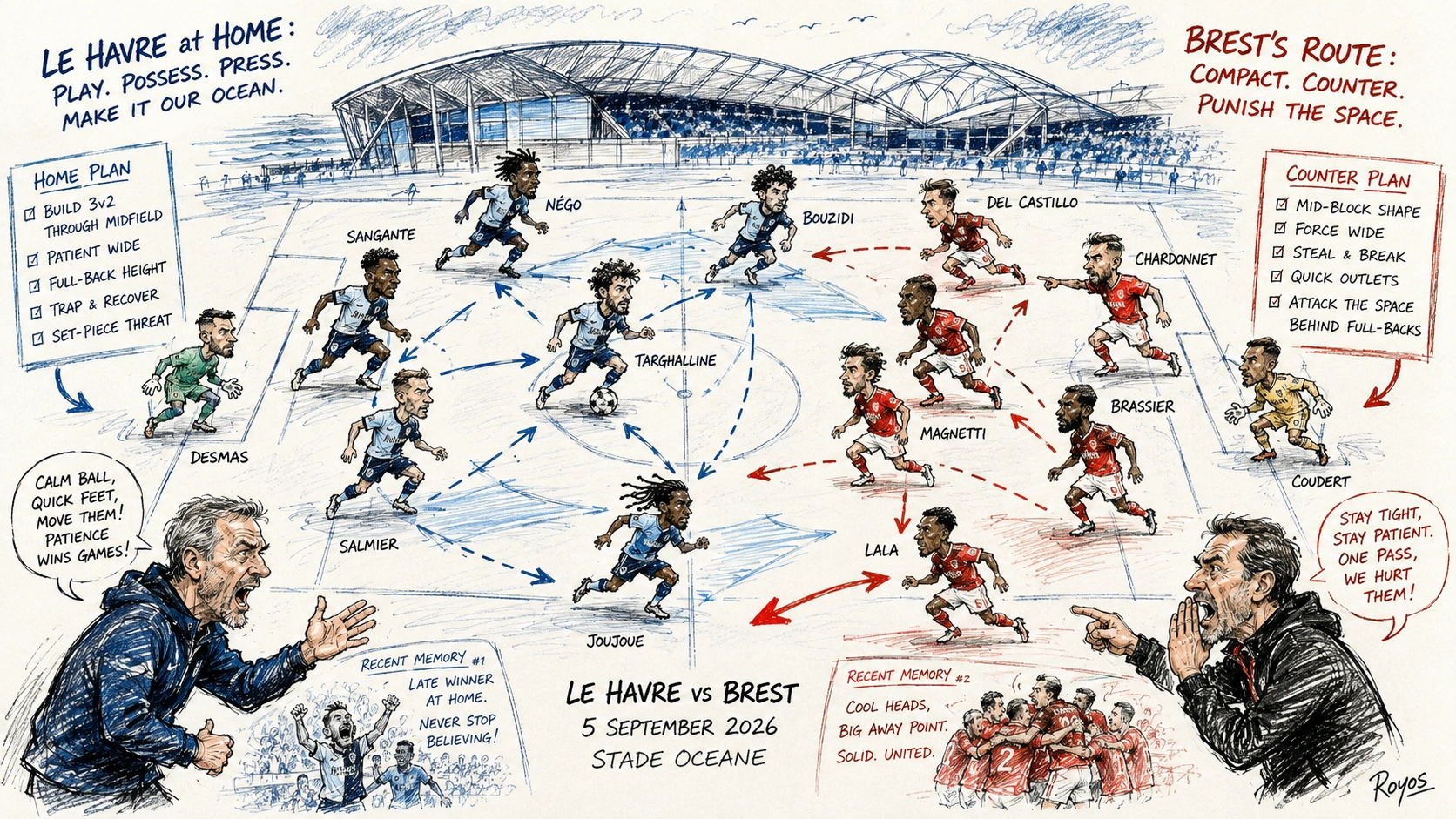
Le Havre's priority is to make possession purposeful. Central combinations, quick switches and direct service into the striker should all be available rather than forcing every attack through one lane.
The likely home XI — Mpasi-Nzau; Seko, Pembele, Touba; Mwanga, Ebonog, Richardson, Ndiaye; Ouziad, Mizuta; Samatta — suggests that spacing will matter as much as individual talent. The deepest midfielders must protect transitions while the forwards occupy different vertical lanes.
At Stade Oceane, the crowd can increase tempo, but the players must not confuse urgency with haste. The best route is layered pressure: territory first, repeated final-third entries second, then an organised counter-press when attacks break down.
However, home has not offered much comfort to the hosts for a while, having failed to win any of their last six at Stade Oceane dating back to last campaign, losing and drawing three each, and they now seek to avoid consecutive defeats in their opening two home matches.
Their last home clash with Brest will offer some optimism, having won 1-0 back in October 2025, ending a run of two straight defeats as hosts in this fixture.
Meanwhile, Brest will hope they can finally cross the line at the third attempt, having drawn their opening two league games against Le Mans and Toulouse.
Brest Analysis
Brest need discipline without passivity. They may spend periods without the ball, but a low block only works if clearances lead to useful exits rather than another wave of pressure.
The projected away XI — Mpasi-Nzau; Seko, Pembele, Touba; Mwanga, Ebonog, Richardson, Ndiaye; Ouziad, Mizuta; Samatta — should be judged on connectivity. The striker needs a nearby passing option, the wide players need clear recovery duties and the midfield must know when to press the receiver and when to protect the space behind.
Transition quality may be the visitors' most valuable attacking tool. One clean pass after regaining possession can bypass several opponents and create a chance before the home side resets.
Julien Lachuer's side recorded a 2-2 draw in their opening game against Le Mans before repeating that scoreline in last weekend's 2-2 draw with Toulouse, this time thanks to a late equaliser from Ludovic Ajorque.
It was a game dominated by Brest in terms of attacking intent, having attempted 27 shots, putting seven on target, while they created six big chances and accumulated 3.04 xG, while limiting Toulouse to six shots, two on target and 1.14 xG.
However, that result extended their winless run in the league to 11 matches (D5, L6), the longest ongoing streak in the competition, although avoiding defeat on Saturday would see them go unbeaten through their opening three games for the first time since 2019-20.
Head-to-Head and Recent Context
The supplied preview gives the relevant recent context for Le Havre vs Brest; no extra historical claims are added beyond that material.
Historical patterns should support, not replace, the analysis of current form. Summer recruitment, injuries and managerial changes can make old results less predictive than the present tactical structure.
Tactical Battle
The central tactical question is the value of protecting an unbeaten start without allowing caution to suppress attacking ambition. Le Havre will want to control the space between midfield and defence, while Brest must stop the home attackers receiving on the half-turn.
Wide areas should matter almost as much as central possession. Advancing full-backs can create overloads, but they also leave transition space behind them.
Second balls can shape the rhythm. The team that reacts first after the initial duel can sustain pressure without needing long possession sequences.
The relationship between the centre-forward and the nearest attacking midfielder is another key. A reliable passing lane into the striker can turn one reception into a wave of support runs.
The first goal should alter the match significantly. A home opener would force Brest to take more positional risks; an away opener would test whether Le Havre can stay patient.
Team News
Le Havre are expected to continue with the 3-4-2-1 system used in their opening matches, with Lionel Mpasi-Nzau in goal and Ayumu Seko, Timothee Pembele and Ahmed Touba forming the defensive trio. Junior Mwanga, Amir Richardson, Simon Ebonog and Rassoul Ndiaye are expected to be the four in the middle, while Kaito Mizuta and Djibril Ouziad provide support for Mbwana Samatta in attack. Stephan Zagadou remains out with a cruciate ligament injury and is not expected back until early 2027, while Felix Mambimbi is recovering from an Achilles problem and Abdoulaye Toure is out with a knee issue. Brest remain without Brendan Chardonnet because of a calf injury, while Justin Bourgault is doubtful, and the absence of Chardonnet leaves Gautier Lloris and Raphael Le Guen as the expected central defensive pairing. However, Romain Del Castillo, who was a major creative and set-piece influence, departed for Osasuna at the end of the window, leaving Mama Balde as the likely candidate for the right side of the attacking three alongside Kamory Doumbia and Pathe Mboup behind Ajorque.
The predicted lineups are the basis of this preview. Players outside those possible XIs are not treated as automatic starters simply because of reputation.
Predicted Lineups
Le Havre: Mpasi-Nzau; Seko, Pembele, Touba; Mwanga, Ebonog, Richardson, Ndiaye; Ouziad, Mizuta; Samatta.
Brest: Mpasi-Nzau; Seko, Pembele, Touba; Mwanga, Ebonog, Richardson, Ndiaye; Ouziad, Mizuta; Samatta.
Key Individual Battles
The centre-forward duel is likely to define the quality of penalty-box work. The striker must occupy the centre-backs strongly enough to create room for supporting runners.
In midfield, the most important duel is positional rather than purely physical. The team that can receive between the opponent's first and second lines should progress more consistently.
Wide attackers can change the height of the defensive block with one successful dribble, especially when supported by an overlap or underlap.
Goalkeeper distribution may become a subtle factor if either side uses the goalkeeper to create an extra passing lane against the press.
Pressing and Build-Up
Le Havre should press with triggers rather than emotion: backward passes, poor first touches and receivers facing their own goal are the moments to increase pressure.
Brest should use the same principle. If the home side are secure in the first line, a mid-block may be more efficient than constant chasing.
Build-up security after attacking set pieces is important because defensive spacing can be distorted when possession changes quickly.
Set-Piece Battle
Dead-ball situations can provide Le Havre with a separate route to goal when open play becomes congested. Blockers, late runs and second-phase deliveries can matter as much as the initial cross.
Brest need strong first-contact defending and control of the edge of the box after any partial clearance.
Discipline is equally important. Avoidable fouls in wide areas give the opponent a free delivery without first needing to beat a defender.
How the Match Could Develop
If Le Havre score first, the match should open in their favour because Brest will need to advance more players and leave more transition space.
If Brest score first, pressure shifts towards the home side and patience becomes essential. Forcing low-percentage passes would suit a deeper visiting block.
A level game after the hour should make substitutions increasingly important, particularly in wide areas where repeated high-intensity runs create fatigue.
The last 15 minutes may reveal which team has managed energy and emotion better, especially if one side decides that a draw is acceptable and the other chases the win.
What the Home Side Must Get Right
Le Havre must make home advantage visible through territory rather than possession percentage alone. The ball needs to spend meaningful time in the final third.
The attacking players need staggered spacing around the box so defenders are forced to choose between stepping out and protecting depth.
The rest-defence structure behind attacks must remain intact, with enough cover to stop the first counter before it gathers speed.
What the Visitors Must Get Right
Brest must avoid being trapped in a purely reactive performance. Even during long spells without the ball, they need a credible attacking outlet.
The first pass after a regain should be treated as a tactical action, not an emergency clearance.
The visitors also need to manage the emotional phases after goals: if they concede, they cannot lose compactness; if they score, they should avoid retreating too deeply.
Why This Fixture Matters
A strong result can reinforce confidence in the early-season plan for Le Havre, while an away result would prove that Brest's approach travels.
One result will not define the campaign, but habits formed now become reference points later: responses to setbacks, protection of leads and the quality of substitutions.
Additional Match Focus
One additional detail worth tracking is the role of Mpasi-Nzau. In the likely structure for Le Havre vs Brest, that position can become a tactical hinge. If the player receives with time, the team can progress cleanly; if pressure arrives early, the next pass may be forced backwards or wide. That apparently small duel can influence the height of the whole team. Supporting players therefore need to provide short passing angles and immediate movement beyond the ball. Without those options, possession becomes predictable. With them, one successful reception can become a sequence of territory, pressure and eventually a high-quality chance. This is another reason the final outcome should depend on collective spacing as much as individual reputation.
Further Tactical Detail 2
One additional detail worth tracking is the role of Seko. In the likely structure for Le Havre vs Brest, that position can become a tactical hinge. If the player receives with time, the team can progress cleanly; if pressure arrives early, the next pass may be forced backwards or wide. That apparently small duel can influence the height of the whole team. Supporting players therefore need to provide short passing angles and immediate movement beyond the ball. Without those options, possession becomes predictable. With them, one successful reception can become a sequence of territory, pressure and eventually a high-quality chance. This is another reason the final outcome should depend on collective spacing as much as individual reputation.
Betting Tips
Full-time result: Draw.
Double chance: Le Havre or Draw.
Both teams to score: Yes.
Over/Under: Under 3.5 goals.
Correct score: Le Havre 1-1 Brest.
No bookmaker odds are attached because none were supplied.
Score Prediction
Goal.mu predicts: Le Havre 1-1 Brest.
The forecast is based on the supplied form, team-news and lineup context. It is the most plausible game script rather than a certainty.
Final Analysis
Le Havre vs Brest should be decided by execution rather than reputation. The key is which team can reproduce its strongest early-season behaviours under pressure.
Goal.mu's final call is <strong>Le Havre 1-1 Brest</strong>, reflecting current form, home setting, likely lineups and the tactical matchup in the supplied preview.
For more football previews and betting analysis, visit our football predictions section before placing your final picks.
The content provided in this article is intended solely for informational and entertainment purposes. Betting and gambling involve significant risks, including the potential loss of the principal amount wagered. Readers should be aware of their local regulations and laws concerning online betting and gambling. Always gamble responsibly, knowing that outcomes are unpredictable and can lead to financial losses.
If you or someone you know may have a gambling problem, please seek help. Many organisations provide resources and support for individuals struggling with gambling-related harm. Remember, the best bet is always a well-informed decision.
Never gamble with funds that are essential for your daily life, and always set limits to ensure that you do not gamble more than you can afford to lose. The thrill of betting should never overshadow the potential consequences of financial loss. Stay safe, stay informed, and gamble responsibly.