Mike Dean’s ‘Mini-Games’ Admission Reopens English Football’s Refereeing Trust Problem
Former Premier League referee Mike Dean’s extraordinary claim that he played private mini-games while officiating has triggered a fresh debate over trust, judgement and accountability in English refereeing.

Mike Dean’s ‘Mini-Games’ Admission Reopens English Football’s Refereeing Trust Problem
There are some stories in football that sound trivial until one extra question is asked. Mike Dean’s latest recollection from his long Premier League refereeing career is one of them.
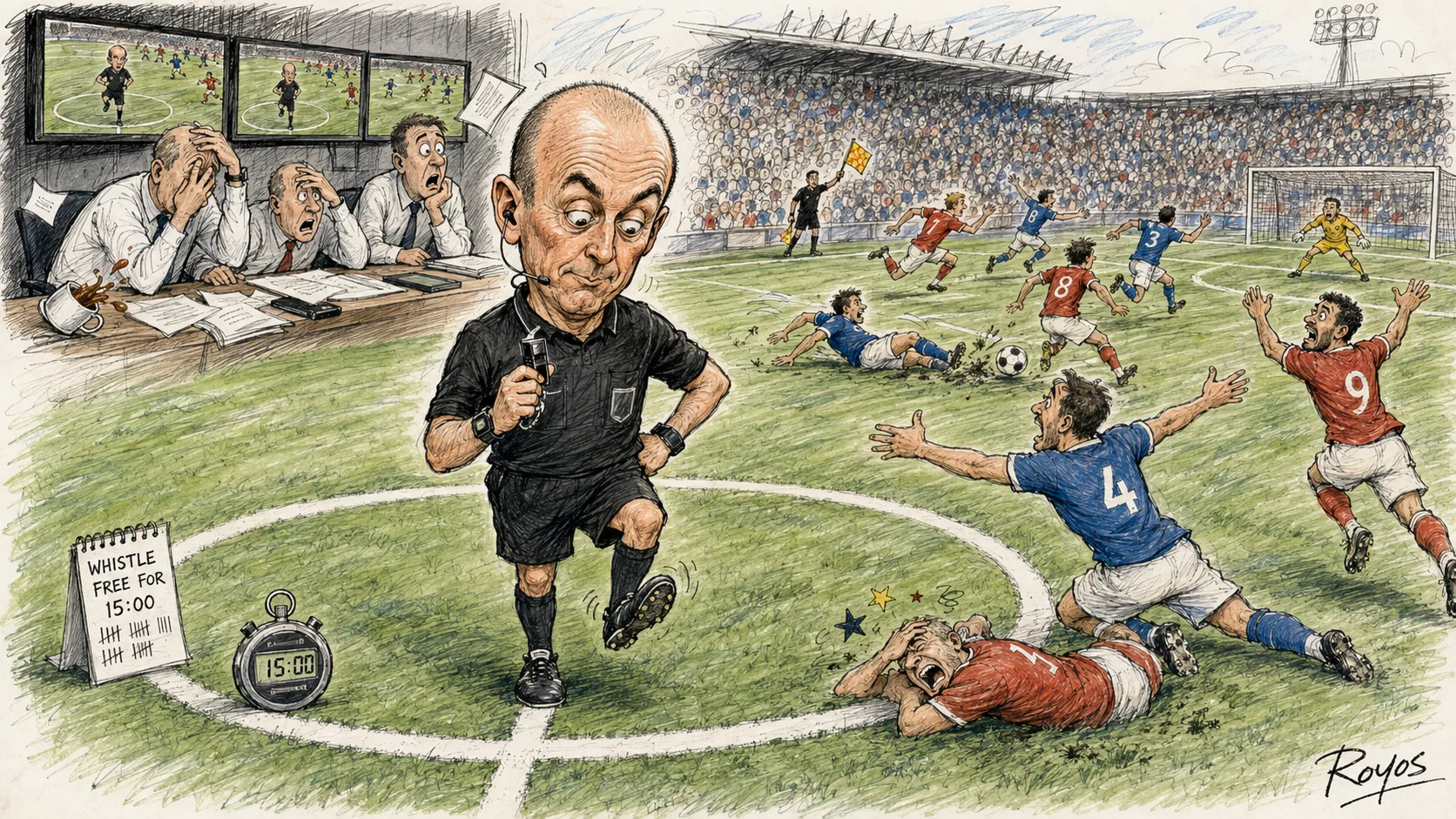
Speaking on former England striker Jamie Vardy’s Having a Party podcast, the former Premier League referee revealed that officials would sometimes set themselves private “mini-games” while matches were taking place. Dean said one challenge involved seeing how long they could go without blowing the whistle, claiming he once managed a spell of around 20 to 25 minutes without using it.
He also described another challenge in which he would try to remain inside the centre circle for as long as possible, recalling one occasion when he stayed there for roughly 15 minutes. The remarks were presented as a humorous behind-the-scenes anecdote, but they have since sparked a far more serious debate about referee concentration, positioning and whether personal challenges should ever have any place inside a professional football match.
Dean said he managed stretches of roughly 20 to 25 minutes without blowing his whistle and recalled another occasion when he stayed around the centre circle for approximately 15 minutes.
The comments were delivered as an entertaining anecdote from a retired official reflecting on life at the highest level, but the reaction was considerably less relaxed. Television pundits responded with disbelief, while the wider discussion quickly moved beyond whether Dean was simply trying to make a podcast story sound amusing.
The central question is more important: should an elite referee ever introduce a personal challenge into a competitive match when his positioning, concentration and judgement can directly influence the contest?
What Mike Dean actually claimed
The first important distinction is between what Dean has said and what has independently been established.
There is currently no publicly identified Premier League match attached to the claims, and there is no evidence establishing that a refereeing decision was deliberately changed to preserve one of these alleged challenges. That distinction matters.
It would therefore be irresponsible to turn an unusual anecdote into allegations of corruption, match-fixing or intentional bias. None of those conclusions follows automatically from Dean’s remarks.
However, it would also be too easy to dismiss the subject as harmless humour. Elite referees occupy positions of enormous responsibility. Their decisions can affect results, league positions, relegation battles, qualification races and, at the highest level, entire seasons.
When somebody with Dean’s experience suggests that personal mini-games formed part of his match-day routine, supporters are entitled to ask whether those challenges ever entered his decision-making process.
Going 20 minutes without a whistle is not automatically suspicious
The no-whistle claim needs particular context because it is easy to misunderstand.
Football referees are not required to use the whistle every time the ball goes out of play. Under modern refereeing guidance, obvious throw-ins, corners, goal kicks and several routine restarts can proceed without a whistle. Referees are also encouraged not to interrupt play unnecessarily and may apply advantage when the team that has been fouled would benefit more from the game continuing.
A long period without hearing a whistle is therefore not, by itself, evidence of poor officiating.
A match can naturally develop into a flowing contest in which there are few significant fouls, obvious restarts and several situations where advantage is preferable to stopping the game.
The concern is not the number of minutes. It is the possibility that reaching a target could become part of the referee’s thinking.
If a referee notices that he has gone 18 minutes without blowing his whistle and then consciously wants to reach 20, the question becomes whether that objective could affect the next marginal decision.
The correct football decision should always determine whether play is stopped. A referee should never be asking whether a foul would ruin a private challenge.
That is why Dean’s choice of language has proved so damaging. Had he merely said that there were matches in which he suddenly realised he had not needed his whistle for 20 minutes, the reaction would probably have been very different.
Describing the situation as a game creates the impression of an independent objective existing alongside the responsibility to referee the match.
The centre-circle challenge is harder to defend
The second claim raises a different and potentially more serious question.
Dean suggested that another challenge involved seeing how long an official could remain in the centre circle, recalling one occasion when he managed around 15 minutes.
Referee positioning is fundamental to elite officiating.
A referee does not simply run around the pitch for fitness purposes. Movement is designed to produce the best possible viewing angle for the next phase of play.
Modern refereeing guidance encourages officials to position themselves so that they can see the ball, the likely point of contact, relevant off-the-ball incidents and the relationship between play and the assistant referees.
That positioning changes continuously.
A quick transition can require the referee to accelerate towards a penalty area. A potential handball may demand a different viewing angle. An off-the-ball confrontation can develop behind the immediate passage of play. A late challenge during a counter-attack may look completely different from 25 metres away than it does from ten.
For that reason, deliberately restricting movement to the centre circle for a prolonged period appears much more difficult to reconcile with the principle that positioning should be determined by the football.
Dean was discussing matches from an earlier refereeing era, and tactical patterns can occasionally keep play concentrated in midfield for significant periods. Nevertheless, if the 15-minute story is literal, identifying the relevant match would provide important context.
Premier League matches are extensively archived. Video could potentially establish whether Dean truly remained inside or around the centre circle for such a long period, whether the recollection has been exaggerated over time or whether the challenge was far less literal than the story suggests.
Why the controversy matters more because of Dean’s previous VAR admission
This is not the first time Mike Dean’s post-refereeing candour has generated uncomfortable questions about the judgement of elite officials.
In 2023, Dean discussed his role as the video assistant referee during Chelsea’s 2-2 Premier League draw with Tottenham in August 2022.
During that match, Tottenham defender Cristian Romero pulled Chelsea’s Marc Cucurella by the hair shortly before Spurs scored an equaliser from the resulting corner.
Dean later acknowledged that he should have recommended an on-field review.
The controversy became considerably more serious when he explained that he had not wanted to send referee Anthony Taylor to the monitor partly because Taylor was a friend and he did not want to create additional difficulty or criticism for him.
That admission was significant because it suggested that a factor unrelated to the football itself had entered the decision-making process.
There is an obvious difference between failing to recommend a VAR review and telling a humorous story about trying not to use a whistle. They should not be treated as the same incident.
Yet the earlier episode changes the context in which Dean’s latest comments are heard.
Supporters are likely to ask whether this represents another example of referees applying considerations beyond the straightforward question of what decision the laws and the incident required.
The uncomfortable meaning of ‘game management’
Referees frequently talk about game management, and the phrase itself is not problematic.
Excellent refereeing requires judgement rather than mechanical intervention.
An official must understand the temperature of a match, communicate with players, recognise when a quiet word may be more effective than an immediate caution, apply advantage intelligently and distinguish between trivial contact and a genuine offence.
That is legitimate game management.
The difficulty begins when management appears to involve objectives that have little to do with applying the Laws of the Game.
Supporters become uncomfortable when they hear suggestions that a referee is thinking about protecting a colleague from criticism, preserving a match as a spectacle, avoiding headlines, achieving a personal challenge or deciding in advance how much intervention a particular fixture should receive.
At that point, the fear is that the official is no longer simply responding to events but is attempting to shape the contest according to a separate philosophy.
English football has encountered this debate before
Dean is not the first prominent former Premier League referee whose post-career explanations have raised questions about the meaning of match management.
Former referee Mark Clattenburg caused controversy when discussing the famous 2016 meeting between Chelsea and Tottenham, a match that ended Spurs’ hopes of winning the Premier League title and confirmed Leicester City as champions.
Clattenburg described approaching the contest with a particular plan and suggested that he allowed Tottenham to self-destruct rather than risk becoming the central figure in the title story through a series of dismissals.
He later argued that his comments had been misunderstood, but the episode highlighted a longstanding tension in refereeing.
Officials regard contextual judgement as an essential part of their craft. Supporters, however, want reassurance that context does not replace consistency.
The referee may understand the emotional temperature of the game, but he must still apply the law to the incident in front of him.
Why public trust is the biggest issue
The modern refereeing debate exists in an environment where public confidence is already fragile.
VAR was introduced partly to reduce the impact of major human errors. Instead, it has also created another layer of scrutiny.
Supporters now compare not only refereeing decisions but also intervention thresholds.
Why did VAR intervene in one match but remain silent during an apparently similar incident in another? Why was one challenge regarded as a clear and obvious error while another was considered subjective? Why was a referee sent to the monitor on Saturday but not on Sunday?
Every decision is compared with another decision.
That means the organisation responsible for elite refereeing must protect credibility as carefully as technical performance.
A referee can make an understandable error and still retain public respect. Football moves quickly, viewing angles are imperfect and even multiple slow-motion replays can produce disagreement.
What damages confidence more deeply is the suggestion that factors unrelated to the immediate incident may have influenced the referee.
The comments affect today’s referees more than Mike Dean
Dean retired from Premier League on-field refereeing in 2022, meaning the immediate operational consequences of his remarks are limited.
The more serious effect is reputational.
Current Premier League officials must enter stadiums every week and convince players, managers and supporters that their decisions are neutral, evidence-based and independent.
Most of those referees had nothing to do with Dean’s alleged mini-games. Modern officiating structures, performance analysis, VAR procedures and training have also evolved considerably.
Yet retired referees remain associated with the institution they once represented.
When one of the Premier League’s most recognisable former officials describes private games inside competitive matches, that story becomes part of the wider public perception of refereeing culture.
That is why the reaction from football analysts has been so strong. The controversy is not really about whether one referee enjoyed entertaining himself during a quiet period of a match. It is about what the admission encourages supporters to believe about the culture of elite officiating.
Mike Dean’s stature makes the story harder to ignore
Dean was not a fringe referee with a brief Premier League career.
He officiated in more than 550 Premier League matches between 2000 and 2022 and became one of the most recognisable officials in English football.
His distinctive gestures, animated expressions and willingness to communicate openly with players made him unusually visible for a referee.
That personality was part of what made Dean popular with some supporters and controversial with others.
It also means his post-career comments attract more attention than those of a lesser-known official.
A colourful anecdote from someone who refereed hundreds of Premier League matches carries institutional weight, whether the speaker intends it to or not.
Dean therefore faces a problem familiar to many high-profile former officials: retirement gives him greater freedom to speak, but his words can still affect confidence in the profession he represented.
What should happen next?
The most constructive response would be transparency rather than sensationalism.
If Dean’s stories were literal, more detail would help establish their significance. Which matches were involved? Did the no-whistle challenge ever affect whether a foul was awarded? Was the centre-circle claim genuinely 15 uninterrupted minutes? Were assistant referees involved in these challenges, or were they simply jokes discussed among colleagues?
Those questions can be asked without assuming wrongdoing.
Equally, English football’s refereeing authorities can use the episode to distinguish historical anecdotes from contemporary standards.
Elite officials today operate within a highly scrutinised environment involving extensive video review, physical monitoring, performance evaluation and detailed analysis of positioning and decision-making.
The strongest institutional response is therefore not anger at a retired referee but clarity about what is expected from those currently working at the highest level.
A referee’s responsibility does not completely disappear in retirement
Former footballers can tell stories about ignoring tactical instructions, arguing with managers or breaking dressing-room rules and often enhance their reputations by doing so.
Referees occupy a more complicated position.
Their professional legitimacy rests heavily on the belief that the football match always mattered more than their personality.
Supporters can accept mistakes. They understand that a referee can miss a shirt pull, misjudge the speed of a challenge or take the wrong viewing angle.
What they find far harder to accept is any suggestion that an official might have introduced an unnecessary personal objective into the contest.
Perhaps Dean embellished the stories for entertainment. Perhaps the no-whistle challenge amounted to little more than allowing matches to flow naturally. Perhaps archived footage would show that the centre-circle claim was much less dramatic than it sounds.
But that uncertainty is precisely why the comments have caused such unease.
The wider lesson for English football
The lasting significance of this story is not whether Mike Dean once completed an unusual personal challenge.
It is the reminder that refereeing authority depends on trust.
Players must trust that two similar challenges will be judged on their merits. Managers must trust that a referee’s positioning is determined by the match rather than a private experiment. Supporters must trust that personal relationships, reputational concerns or entertainment value are not influencing decisions.
No refereeing system can eliminate human judgement. Football is too fast, too subjective and too emotionally charged for that.
But the principle governing that judgement must remain simple: every decision should be made because it is the best decision for the football situation in front of the referee.
No private challenge. No personal agenda. No concern about protecting a colleague from criticism.
For Mike Dean, the story may have been intended as an amusing glimpse behind the curtain of Premier League refereeing.
Instead, it has reopened one of the most sensitive debates in English football.
How much discretion should a referee possess, and where is the line between intelligent game management and allowing considerations outside the Laws of the Game to influence a match?
That is a question far more important than whether a whistle remained silent for 20 minutes.
And for the officials responsible for rebuilding confidence in Premier League refereeing, it is precisely the sort of question they would probably rather a former colleague had not given supporters another reason to ask.